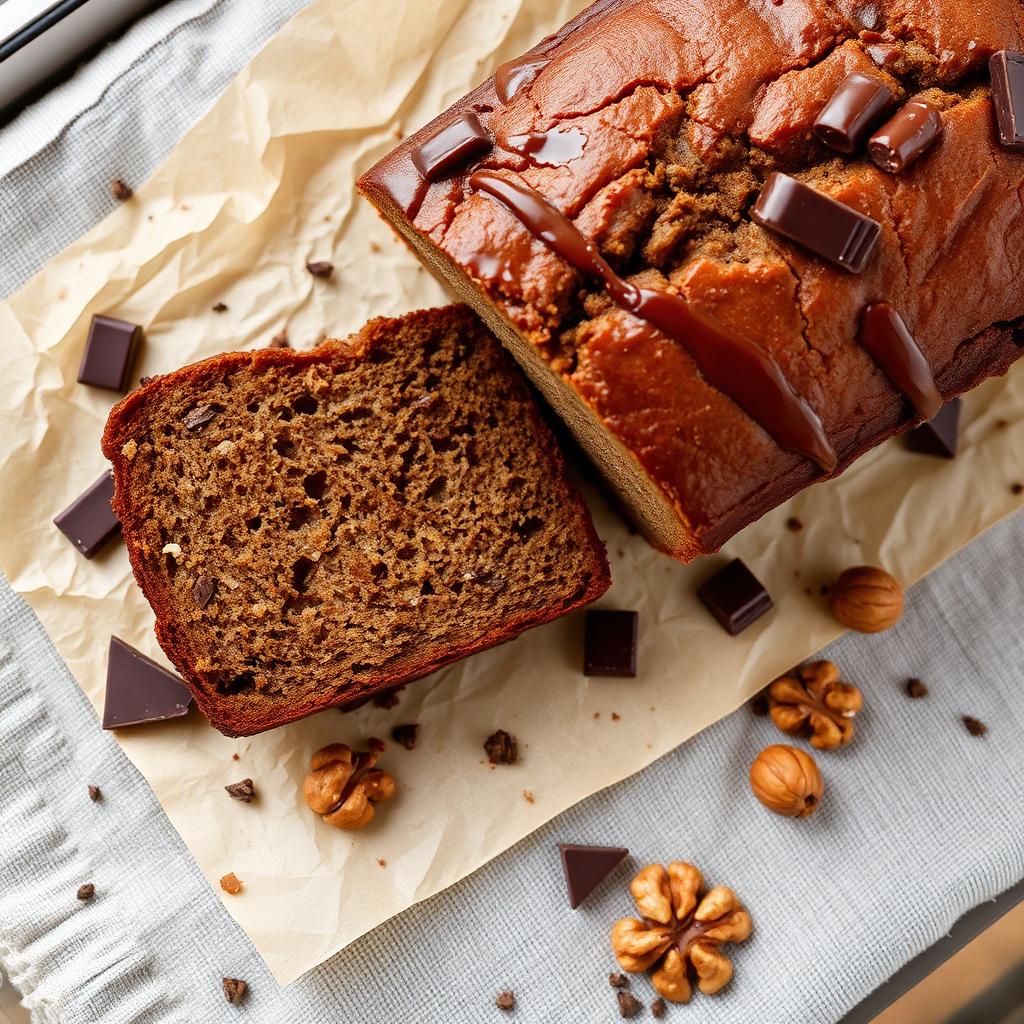
There is a specific, quiet alchemy that occurs when fruit passes its prime and begins to lean into the fermenting sweetness of neglect. For years, I viewed a blackening banana as a failure of time management—a grocery store casualty destined for the bin. But then I discovered the transformative power of brown butter. By toasting the milk solids until they take on the character of burnt honey and crushed nuts, we create a structural foundation that can handle the aggressive, almost wine-like sugar profile of an overripe banana. This isn't the airy, pale yellow quick-bread of a suburban bake sale. This is a heavy, dark, brooding loaf, punctuated by the sharp bitterness of 70% dark chocolate. It is a recipe for the patient, for those who understand that the best things often come from the edges of what we once considered spoiled. It is bread that feels like a weighted blanket for the soul.
The story
Why this one stuck
In the coastal town of Mendocino, there was a house that smelled perpetually of damp cedar and salt air, owned by a woman named Elara who didn't believe in timers. She was a potter by trade, her hands always filmed in a thin translucent layer of gray clay, and her kitchen was a chaotic gallery of 'almost-forgotten' things. On her counter, there was always a bowl of bananas that looked more like charcoal than fruit—skins so thin and black they seemed capable of bruising at a harsh word. Most people would have thrown them away, but Elara saw them as a resource. She taught me that the peak of a banana isn't when it's beautiful and yellow; it's when it has reached a state of total surrender.
One afternoon, as the fog rolled in off the Pacific like a thick wool curtain, she showed me the secret of the butter. She didn't just melt it; she transformed it. We stood over a small, battered copper pot, watching the golden liquid froth and spit until a scent filled the room that I can only describe as 'brown.' It was the smell of old libraries, of toasted brioche, of the very end of autumn. She told me that the butter was the bridge—it connected the wild, messy sweetness of the dying fruit to the sophisticated, structural requirements of a cake.
We chopped chocolate that she kept in massive, irregular blocks, using a heavy cleaver that made a satisfying 'thwack' against the wooden board. There was no precision in her measurements, yet the result was always consistent: a loaf so dense it felt like it had its own gravity, with a crust that crackled like parchment. We would sit on her porch, wrapped in heavy sweaters, eating thick slices while the chocolate was still soft enough to smear. We didn't talk much. The bread did the heavy lifting. Now, every time I stand over my own stove, watching the butter foam and listen to the silent 'pop' of the milk solids turning dark, I am back in that cedar-scented kitchen. This recipe is my attempt to codify Elara’s intuition into something you can recreate in your own kitchen, a bridge between the fruit we forgot and the comfort we desperately need. It is a tribute to the beauty of the overripe and the power of a little heat to turn a common ingredient into something mythic.
What you'll need
Ingredients
- 115g (1 stick) Unsalted high-fat European-style butter
- 350g (approx 3 large) extremely overripe bananas, mashed into a smooth pulp
- 150g Dark brown sugar, packed tightly
- 50g Granulated white sugar
- 2 Large eggs, room temperature
- 60g Full-fat Greek yogurt or sour cream
- 10ml (2 tsp) Pure vanilla bean paste or extract
- 250g All-purpose flour, sifted
- 5g (1 tsp) Baking soda
- 3g (1/2 tsp) Fine sea salt
- 4g (1 tsp) Ground cinnamon
- 1g (1/4 tsp) Freshly grated nutmeg
- 150g Dark chocolate (70% cacao), roughly chopped into irregular shards
- Flaky sea salt for finishing (optional)
Step by step
How to make it
- 01
Begin by browning the butter in a light-colored stainless steel saucepan over medium heat. As the water evaporates, the butter will hiss and bubble aggressively before settling into a quiet, foamy state. Watch for the milk solids to turn a deep, autumnal chestnut brown and smell like toasted hazelnuts. Immediately remove from heat and pour into a large, heat-proof mixing bowl, making sure to scrape out every single dark speck. Allow it to cool for 10 minutes.
- 02
While the butter cools, prepare your 9x5-inch loaf pan by greasing it lightly and lining it with a 'sling' of parchment paper that hangs over the long sides. This ensures you can lift the delicate loaf out later without disturbing the crust. Preheat your oven to 350°F (175°C), positioning the rack in the lower-middle third to allow for even heat distribution around the dense batter.
- 03
In the bowl with the cooled brown butter, whisk in the dark brown sugar and granulated sugar. The mixture will look like wet sand. Whisk vigorously for two minutes; the sugar won't fully dissolve, but the friction helps integrate the fats. Add the eggs one at a time, whisking until the batter looks glossy and emulsified. Stir in the Greek yogurt and vanilla bean paste until no white streaks remain.
- 04
In a separate medium bowl, mash the bananas until they reach the consistency of thick porridge. Fold this banana pulp into the wet ingredients using a silicone spatula. The acidity in the bananas and yogurt will later react with the baking soda to provide the necessary lift, so ensure they are thoroughly combined but do not overwork the mixture at this stage.
- 05
Sift the flour, baking soda, sea salt, cinnamon, and nutmeg over the wet ingredients. Sifting is vital here to prevent clumps of soda which can cause a metallic aftertaste. Using a large spatula, fold the dry ingredients into the wet using a 'J' motion—cut through the center, scrape the bottom, and fold over. Stop when only a few faint streaks of flour remain visible.
- 06
Gently fold in three-quarters of the chopped dark chocolate shards. Holding back a portion of the chocolate allows you to top the loaf artistically, ensuring every slice looks as decadent as it tastes. Be careful not to over-mix; the batter should be thick, heavy, and fragrant with the scent of toasted butter and warm spices. It will look significantly darker than standard banana bread.
- 07
Transfer the batter into the prepared loaf pan, smoothing the top with the back of a spoon. Scatter the remaining chocolate shards over the surface, pressing them slightly into the batter so they stay put during the rise. If using, sprinkle a generous pinch of flaky sea salt over the top to contrast the richness of the sugars and the bitterness of the cacao.
- 08
Bake for 60 to 70 minutes. Because of the high moisture content from the bananas and the density of the brown butter, this loaf needs time. Check it at 55 minutes; if the top is a deep mahogany, tent it with foil. The loaf is finished when a skewer inserted into the thickest part of the dome comes out clean or with just one or two moist crumbs. Avoid hitting a chocolate pocket, which will give a false wet reading.
- 09
Remove from the oven and let the bread cool in the pan for at least 20 minutes. This 'carry-over' cooking time is essential for the internal structure to set properly. If you cut it too soon, the steam will escape and the crumb may turn gummy. After 20 minutes, use the parchment sling to lift the loaf onto a wire rack to cool completely before slicing. Patience is rewarded with a perfect, velvety mouthfeel.
Cook's notes
Tips for your best result
- 01Use a light-colored pan for browning the butter so you can accurately judge the color of the milk solids; in a dark pan, you risk burning them before you see the change.
- 02Choose bananas that have zero yellow left on the skin; the more black spots, the higher the sugar content and the deeper the banana flavor.
- 03Chop your chocolate into varying sizes, from dust to half-inch chunks, to create a textured 'mosaic' effect within the crumb.
- 04Room temperature eggs are non-negotiable; cold eggs will cause the browned butter to seize and clump, ruining the emulsion of the batter.
- 05Don't skip the Greek yogurt—the acidity is required to activate the baking soda and create a tender, moist interior without adding excess liquid.
Make it yours
Variations
While this loaf is a masterpiece of dark tones and rich fats, it offers a sturdy canvas for seasonal interpretation. For a more textural, earthy experience, you might fold in 100g of toasted, roughly crushed walnuts or pecans along with the chocolate. The tannins in the nuts play exceptionally well with the bitterness of the 70% cacao. If you prefer a brighter, more aromatic profile, add the zest of two large oranges to the sugar before whisking; the citrus oils cut through the richness of the brown butter like a sharp blade of light. For those who enjoy a hint of the avant-garde, replace the ground cinnamon with 2 grams of ground cardamom and a half-teaspoon of ground ginger; this shifts the flavor profile toward something more reminiscent of a Persian spice market. If you find yourself without dark chocolate, roasted cocoa nibs provide a similar crunch and bitterness without the melting, resulting in a cleaner-looking slice. Finally, for a truly decadent version, you can swirl a tablespoon of tahini into the top of the batter just before baking; the savory, sesame-rich swirls create a mesmerizing marble effect against the dark chocolate shards.
Keep it fresh
Storage & make-ahead
This bread is actually superior on the second day, once the oils from the butter and the moisture from the bananas have had time to fully migrate through the crumb. Store it at room temperature, wrapped tightly in plastic wrap or kept in an airtight container, for up to 4 days. If you find yourself with leftovers beyond that, slice the loaf and wrap individual pieces in parchment paper followed by foil. They can be frozen for up to 3 months. To serve from the freezer, toast the frozen slice directly in a toaster oven; the exterior will crisp up beautifully while the chocolate pockets remain molten. Never refrigerate this bread, as the cold environment will cause the starches to recrystallize and the butter to harden, resulting in a dry, unpleasant texture that masks the complex flavors of the toasted milk solids.
Reader questions
Frequently asked
How ripe do my bananas actually need to be?
Bananas are ready when their skins are almost entirely black and feel liquid inside. If yours are only yellow-spotted, roast them in their skins at 300°F for 15 minutes until they weep. This concentrates the sugars and breaks down the starches into a syrup-like consistency that is essential for the moisture profile of this specific loaf. Avoid unripe bananas at all costs; they lack the necessary structural sugar.
What is the difference between melted and browned butter here?
Brown butter is butter that has been cooked until the water evaporates and the milk solids toast. In this recipe, we keep those sediment-heavy 'brown bits' because they carry the intensely savory, hazelnut-like aroma. Looking for a deep amber color, similar to a weathered penny, ensures you've achieved maximum Maillard reaction without crossing the line into the acrid bitterness of burnt fat. Always watch the foam closely as it indicates the final stages.
Why is my banana bread tough or rubbery?
The crumb of this bread relies on a delicate balance of moisture and aeration. Over-mixing activates the gluten, turning a tender, cake-like slice into something rubbery and tough. Fold the dry ingredients in only until the last white streak of flour vanishes. If you see a few small lumps, leave them be. The heat of the oven will dissolve them, while the integrity of the crumb remains intact and melt-in-your-mouth soft.
Can I use standard chocolate chips instead of chopped chocolate?
Ideally, use a bar of high-quality dark chocolate (70% cocoa or higher) and chop it by hand. This creates a mix of large 'pools' and tiny 'shards' that distribute throughout the batter. Pre-packaged chocolate chips contain stabilizers like soy lecithin that prevent them from melting properly, which interrupts the velvety texture we are aiming for. Hand-chopped chocolate creates a more sophisticated, irregular internal landscape in every single slice you cut.
My bread is browning too fast but the center is still raw. What do I do?
Elevation, oven calibration, and the moisture content of your bananas can all affect timing. Start checking for doneness at the 55-minute mark. A wooden skewer should come out with a few moist crumbs attached, but no wet batter. If the top is browning too rapidly while the center remains liquid, tent the loaf loosely with aluminum foil for the final 15 minutes to protect the crust.
Is it really necessary to weigh the ingredients?
Measuring flour by weight (grams) is the only way to ensure the ratio of fat to starch is perfect. A 'cup' of flour can vary by up to 30 grams depending on how tightly it is packed, which is the difference between a moist loaf and a dry, crumbling one. This recipe is engineered for a specific hydration level, so if you must use cups, fluff the flour first and level it precisely.