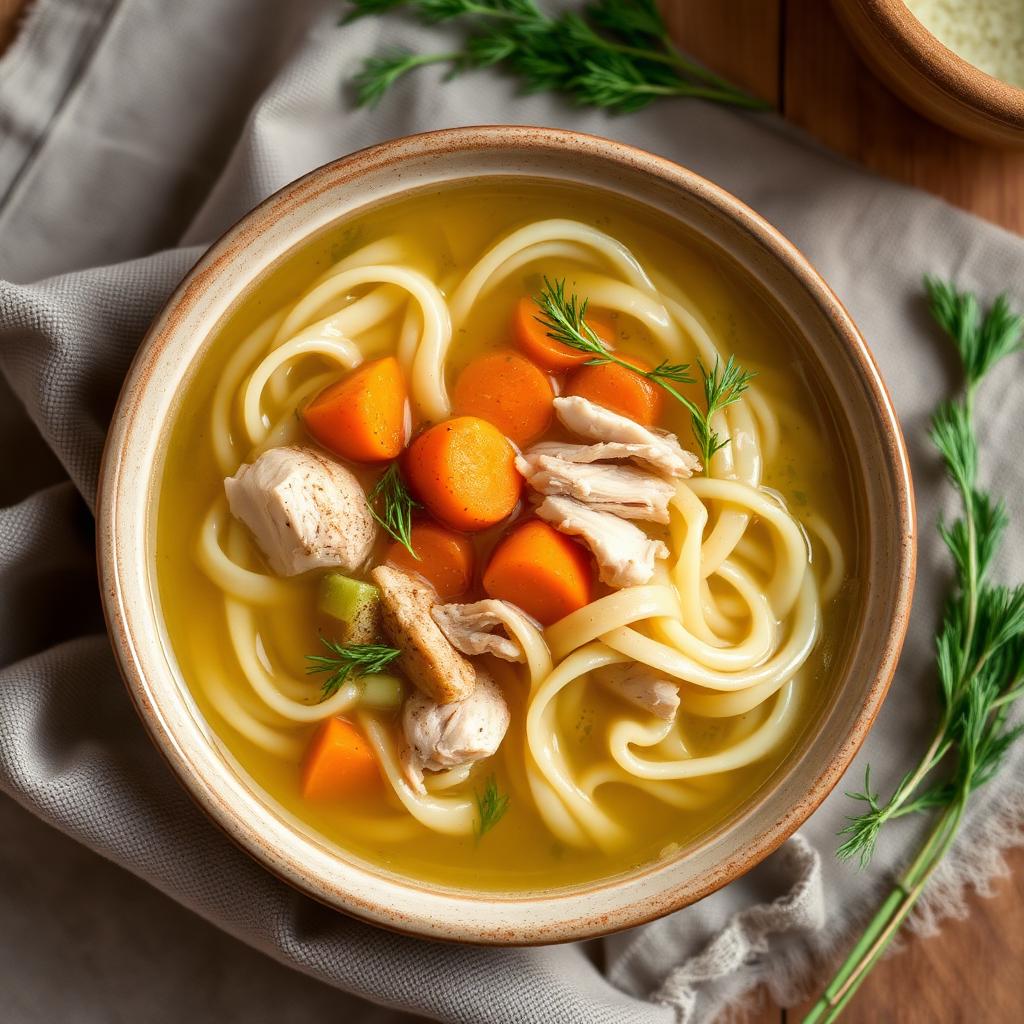
There is a profound, almost religious quiet that settles over a kitchen when a proper chicken soup is on the stove. This isn’t the frantic, high-heat energy of a Tuesday night stir-fry; it is the slow, rhythmic labor of an afternoon given over to the alchemy of bone and water. This recipe is a reclamation of the term 'from scratch.' We are not opening cartons here. We are building a golden cathedral of flavor starting with a whole bird, a handful of garden aromatics, and the patience of a saint. The resulting broth is not merely salty water; it is a viscous, silk-textured elixir that coats the back of a spoon and cures the kind of fatigue that sleep cannot touch. This version utilizes hand-torn, yolk-heavy noodles that provide a chewy, rustic counterpoint to the clarity of the broth. It is a dish that demands you slow down, breathe in the steam, and remember that some things simply cannot be rushed.
The story
Why this one stuck
I remember the winter of 1996 not by the snow, but by the smell of damp wool and parsnips. We were living in a drafty Victorian in the Hudson Valley, a house that breathed through its floorboards and groaned under the weight of the wind. My grandmother, Agnes, was a woman of few words and very sharp knives. She didn’t believe in 'quick' anything. To her, time was an ingredient as tangible as salt. She would sit in a ladder-back chair by the window, peeling carrots with a precision that bordered on the surgical, the orange ribbons falling into a ceramic bowl like shavings from a carpenter’s plane.
She taught me that a chicken is not just meat; it is a mapping of flavor. 'The bones hold the history,' she would say, tapping her knuckle against the stockpot. We would start at noon. The chicken would go in whole—never pieces, because the skin and the carcass needed to communalize. I can still see the steam rising, fogging the windows until the world outside disappeared, leaving only us and the bubbling copper pot. The house would transform from a cold, hollow shell into a warm, amber-scented sanctuary.
The noodles were my job. She would clear the heavy oak table and mound flour into a volcano. Breaking the eggs was a ritual; I had to be careful not to let a single shard of shell touch the yellow pools. My small hands would work the dough until my wrists ached, but the reward was the rolling. We would roll those sheets until they were thin enough to see the grain of the wood beneath them. We didn't use a cutter. We used a dull butter knife to hack out uneven, wide ribbons. They were 'ugly' by professional standards, but in the bowl, they looked like silk ribbons caught in a golden current.
One evening, when a particularly nasty nor'easter had knocked out the power, we ate this soup by candlelight. The broth glowed like liquid gold in the dim light. There was no television, no hum of the refrigerator—just the scrape of spoons against porcelain and the wind rattling the glass. That soup wasn't just lunch; it was a barrier against the cold, a proof of safety. Every time I make this now, I am trying to find my way back to that table, to that quiet, and to the woman who taught me that the best things in life are the ones that take four hours and a lot of heart to build. Every bubble in this pot is a memory of her.
What you'll need
Ingredients
- For the Golden Broth
- 1 whole 4-lb pasture-raised chicken, neck and giblets included (discard liver)
- 2 large yellow onions, unpeeled and halved
- 3 large carrots, cut into 3-inch chunks
- 2 parsnips, peeled and halved
- 1 leek, dark green tops only (save whites for the soup)
- 1 head of garlic, halved crosswise
- 1 tablespoon black peppercorns
- 1 small bunch fresh thyme
- 1 bunch flat-leaf parsley (stems only)探,
Step by step
How to make it
- 01
Phase One: The Foundations. Place the whole chicken, neck, and giblets into a heavy 8-quart stockpot. Add the halved onions (keep the skins on for a deeper amber color), the 3-inch carrot chunks, parsnips, leek tops, garlic, peppercorns, and herbs. Pour in 5 quarts of cold filtered water. It is vital the water is cold to start, as this slowly coaxes the impurities to the surface for a clearer result.
- 02
The Gentle Simmer: Set the burner to medium-high until the first signs of movement appear on the water's surface. As foam rises, use a fine-mesh skimmer or a spoon to remove the greyish froth. Once it reaches a bare simmer (about 190°F), reduce the heat to low. The surface should barely tremble. Do not let it boil vigorously, as this will emulsify the fat and create a cloudy, greasy broth. Simmer uncovered for 1 hour and 15 minutes.
- 03
The Extraction: Using tongs, carefully lift the whole chicken out of the pot and place it on a large baking sheet to cool. The meat should be tender but still holding shape. Continue simmering the vegetables and bones remaining in the pot for another 2 hours. This second stage is where the deep mineral flavors are extracted from the marrow and the vegetables surrender their sweetness entirely.
- 04
Shredding the Bird: Once the chicken is cool enough to handle, remove the skin and discard. Pull the meat from the bones in large, rustic chunks—avoid fine shredding, as you want substantial bites of protein. Place the picked meat in a bowl, cover with a damp paper towel, and refrigerate. Return all the bones and cartilage back into the simmering stock pot to continue the flavor extraction.
- 05
The Great Clarification: After the 3-hour mark, the broth should be a deep, shimmering gold. Set a large fine-mesh sieve lined with cheesecloth over a clean pot. Carefully strain the liquid, discarding all the spent solids. You should have roughly 3 to 4 quarts of liquid. Taste it now; it should taste like the essence of poultry. If it feels thin, simmer it for another 20 minutes to concentrate. Store in the fridge overnight to easily lift off the fat cap, or skim with a spoon if serving immediately.
- 06
The Hand-Torn Noodles: On a clean wooden board, make a mound of flour with a deep well in the center. Add the eggs, yolks, and salt. Using a fork, whisk the eggs while slowly drawing in flour from the edges. When a shaggy dough forms, knead by hand for 10 minutes until smooth and elastic. Wrap in plastic and let rest for at least 45 minutes—this is non-negotiable for gluten relaxation.
- 07
Rolling and Cutting: Divide the dough into four pieces. On a floured surface, roll each piece out until it is paper-thin and translucent. Do not worry about perfect edges. Let the sheets air-dry for 15 minutes, then loosely fold them and slice into wide, irregular ribbons (about 1/2 inch). Toss with extra flour to prevent sticking. These rustic, uneven edges are what give the soup its soul.
- 08
The Final Assembly: In the clean pot, heat a tablespoon of olive oil. Add the diced leek whites, diced carrots, and celery. Sauté over medium heat for 6-8 minutes until softened but not browned. Pour in the strained broth and bring to a gentle boil. Add the hand-torn noodles and cook for 3-5 minutes until they float and are tender but firm. Check the seasoning and add salt and black pepper generously.
- 09
The Finishing Touch: Fold in the chilled chicken pieces and the remaining fresh parsley. Simmer for just 2 minutes more to warm the meat through. The residual heat from the broth will gently revive the chicken without toughening it. Turn off the heat and let the soup settle for five minutes before ladling into deep, wide bowls. The broth should be the star, with the noodles and chicken acting as the supporting cast.
Cook's notes
Tips for your best result
- 01Don't discard the onion skins; they contain a natural pigment that gives your broth a rich, golden-amber hue that looks far more appetizing than a pale, grey stock.
- 02The cold-water start is the most important rule. It allows the proteins to release slowly, ensuring they coagulate into larger clumps that are easier to skim, resulting in a cleaner flavor.
- 03Rest the noodle dough. If you try to roll it immediately after kneading, the gluten will snap back like a rubber band and your noodles will be tough and thick.
- 04Use a pasture-raised chicken if possible. The diet of the bird directly impacts the color of the fat (the schmaltz), which provides the flavor and 'soul' of the soup.
- 05Salt in stages. Season the broth lightly at the beginning, but do the final heavy seasoning at the end after the liquid has reduced to avoid an over-salted pot.
- 06When sautéing the soup vegetables at the end, use a small amount of the chicken fat (schmaltz) skimmed from the top of the stock for an extra layer of poultry essence.
Make it yours
Variations
While the classic version is a purist's dream, this recipe acts as a sturdy skeleton for seasonal improvisation. In the height of spring, I often omit the parsnips and instead whisk in a handful of smashed peas and thin ribbons of wild leeks (ramps) during the final three minutes of simmering. To give it a bright, Mediterranean lift, you can whisk two eggs with the juice of two lemons and slowly temper it into the hot broth at the very end to create an Avgolemono-style texture—creamy, tart, and incredibly restorative. If you crave heat, a tablespoon of freshly grated ginger and a few cloves of smashed garlic added to the final vegetable sauté will transform the profile into something that clears the sinuses and warms the throat. For a more 'forest-inspired' version, replace the noodles with wild rice and add a handful of dried porcini mushrooms to the initial simmering stock; the mushrooms will lend a dark, umami-heavy complexity that feels grounded and prehistoric. Regardless of the path you take, the core technique of the long-simmered whole bird remains the non-negotiable heart of the dish. Never be tempted to use bouillon cubes to 'boost' the flavor; the purity of the chicken is its own reward.
Keep it fresh
Storage & make-ahead
Stock-based soups are famously better the next day, but there is a caveat: the noodles. If you intend to have leftovers, I implore you to store the noodles and the broth in separate containers. The noodles will continue to swell and absorb liquid as they sit, eventually turning into a thick porridge. The broth itself will keep beautifully in the refrigerator for up to 4 days, or in the freezer for 6 months. To reheat, bring the broth to a simmer first, then drop in your reserved noodles or boil a fresh batch. If the refrigerated broth has turned into a solid jelly, do not panic—that is the sign of a high-collagen, successful stock. It will liquefy instantly when it touches the heat, revealing a depth of flavor that only develops with a cold rest. When reheating, always check the seasoning again, as cold temperatures can mute the perception of salt and pepper.
Reader questions
Frequently asked
Why does this bouillon taste more 'viscous' than store-bought stock?
Unlike the thin, salty liquid in cans, this broth is a complex emulsion of gelatin, fat, and vegetable sweetness. By simmering the whole bird with the skin on, you are extracting collagen that creates a silky mouthfeel. It shouldn't just be 'wet'; it should feel like it is hugging your spoon. Achieving this requires patience and the restraint not to boil the liquid into a cloudy mess.
How do I prevent the noodles from becoming bloated and soft?
The 'mushy noodle' is the enemy of a peaceful meal. If you plan on eating the soup over several days, store the cooked noodles separately in a container tossed with a drop of oil. Only combine them in the individual bowls when serving. If you cook them in the pot and let them sit, they will act like sponges, drinking up your precious golden broth and turning into a thick paste.
Can I use warm water to speed up the boiling process?
Always start with cold, filtered water. Starting with hot water from the tap can pull minerals from your pipes into the pot, giving the soup a metallic tang. Cold water allows the proteins in the chicken to dissolve slowly and rise to the top as foam, which you can easily skim off. This results in a crystal-clear consommé-style base rather than a murky or gritty soup.
Is the parsnip truly necessary for the flavor profile?
Parsnips are the secret weapon of the European stockpot. While carrots provide a straightforward, sugary sweetness, parsnips offer a complex, earthy, slightly spicy undertone that mimics the scent of an autumn forest. They ground the brightness of the celery and onion, adding a three-dimensional depth that makes people stop and ask, 'What is that secret ingredient?' It is the bridge between the meat and the herbs.
What is the difference between using just onions versus adding leeks?
Yellow onions are the workhorse for depth, but the leek adds a creamy, sophisticated sweetness that is much more subtle. Crucially, the leek needs to be cleaned thoroughly. Slice it lengthwise and run it under cold water to dislodge the grit trapped between the layers. The white and light green parts are what you want; save the dark green tops for the initial stock-building phase to maximize waste-free cooking.
Should I use fresh or dried herbs for the bouquet garni?
Dry herbs are often dusty and muted by the time they reach your cupboard. Fresh thyme and parsley stems provide a bright, volatile oil profile that cuts through the richness of the chicken fat. The stem of the parsley actually contains more concentrated flavor than the leaf, which is why we tie them into a bouquet garni. It allows the essence to infuse without leaving tiny green specks everywhere.