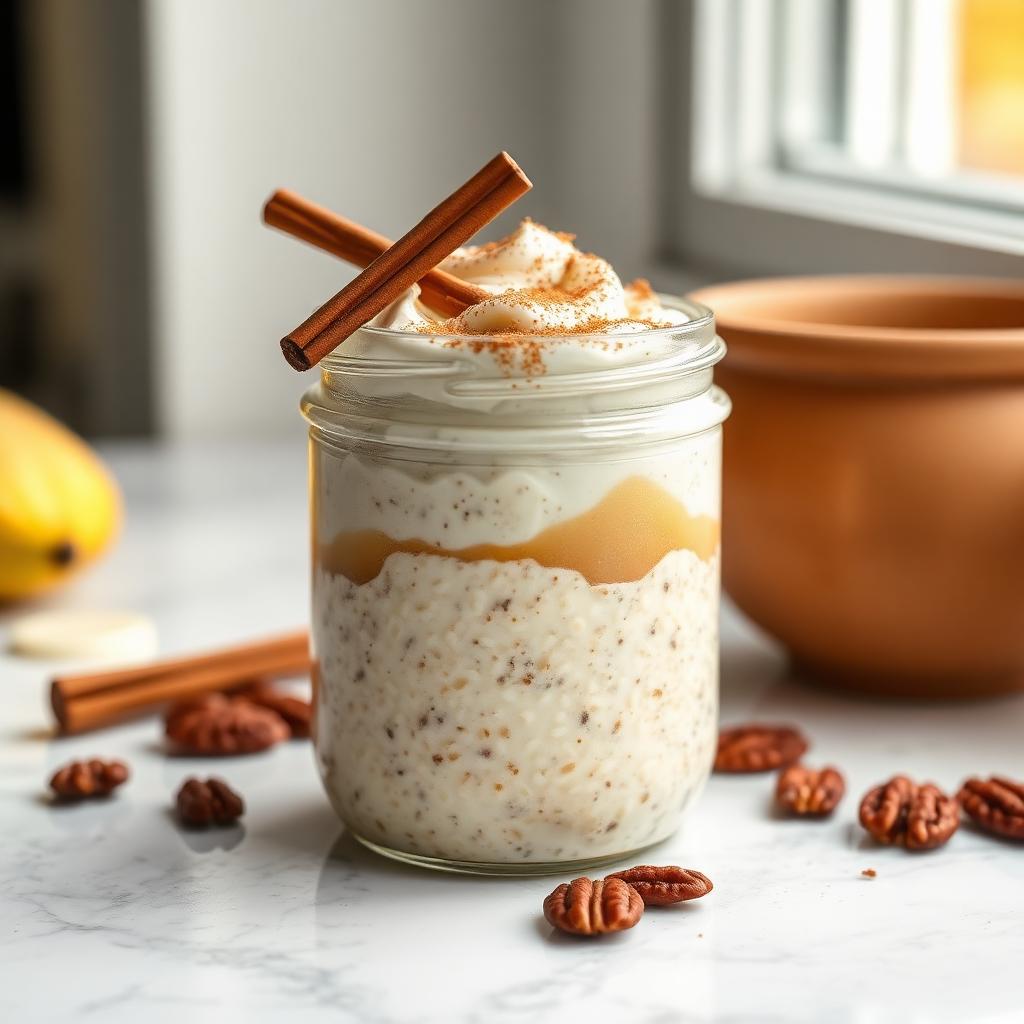
There is a specific kind of quiet that only exists at 5:00 AM in a house warmed by an industrial oven. This recipe is an attempt to capture the essence of a cinnamon roll—not the dry, bready exterior, but the molten, spice-heavy heart that yields under the pressure of a fork. These overnight oats are a departure from the depressing, soggy grains of health-food lore. Instead, they are a layered, architectural achievement of breakfast. We are mimicking the structural logic of a pastry: a dense, vanilla-scented base, a concentrated ribbon of cinnamon-date intensity, and a crowning glory of maple-infused cream that mimics the best cream cheese frosting. It is a meal that demands you slow down, even if you’re eating it at a desk or in the car. It is rich, nostalgic, and mathematically balanced between the bite of salt and the velvet of maple. This is breakfast as poetry, prepared by your past self for a future you who deserves a little kindness.
The story
Why this one stuck
My grandmother, Eloise, lived in a house that smelled perpetually of yeast and high-grade Indonesian cinnamon. She didn't cook from books; she cooked from the humidity in the air and the way the light hit the flour on her workspace. She had a specific ritual for cinnamon rolls that involved three separate proofing stages and a stubborn refusal to use anything but a heavy porcelain bowl. I remember sitting on her linoleum floor, watching her hands move with the precision of a surgeon, tucking brown sugar and butter into the folds of the dough like she was whispering secrets into the grain.
The center of the roll was the prize. We called it 'the heart.' It was the part where the spice had mutated into a dark, syrupy nectar, and the dough was so saturated with fat and sugar that it almost ceased to be bread and became a confection. She would always give me the center piece of the tray, hidden under a snowy mountain of glaze she’d whipped by hand until her forearms ached.
Decades later, in a cramped apartment with a job that demanded I be awake and functioning long before the sun had the decency to rise, I found myself craving that specific 'heart.' I didn't have four hours to proof dough or the patience for a rolling pin. I needed that flavor memory, but I needed it to fit into a life that was constantly moving. This recipe was born in that tension.
It started as a failure. A bowl of gray, uninspired oats that tasted of nothing but sadness and health-trends. I realized I was approaching it too simply. To recreate Eloise’s spirit, I had to layer. I had to treat the oats not as a porridge, but as a medium for spice. I began swirling the cinnamon in a concentrated paste, mimicking the way she spread the filling onto the dough. I switched from plain sugar to maple, seeking that earthy, wood-smoke depth that sugar alone can't provide. And the cream—plain yogurt was too sharp, too clinical. It needed to be whipped into submission with maple and vanilla to mimic her legendary frosting.
Now, when I crack open one of these jars in the early morning, the scent of Saigon cinnamon hits me first—sharp and aggressive—followed by the mellow, floral note of the vanilla bean. It isn't her kitchen, and there is no linoleum floor, but for a few minutes, as the maple cream melts into the spiced oats, I am ten years old again, watching the flour dust dance in a shaft of morning light. This is my way of keeping her ritual alive in a world that rarely stops to let the dough rise.
What you'll need
Ingredients
- For the Oat Base
- 2 cups old-fashioned rolled oats (GF certified if necessary)
- 1.5 cups unsweetened vanilla almond milk
- 1/2 cup plain Greek yogurt or thick coconut yogurt
- 2 tablespoons black chia seeds
- 1 tablespoon pure maple syrup, grade A amber
- 1 teaspoon pure vanilla bean paste
- 1/2 teaspoon ground Ceylon cinnamon
- 1/4 teaspoon fine sea salt
- For the Cinnamon Swirl
- 2 tablespoons almond butter, smooth and drippy
- 1 tablespoon maple syrup
- 1 teaspoon ground Saigon cinnamon (for heat)
- 1 tablespoon warm water to thin
- For the Maple Cream Topping
- 1/2 cup chilled coconut cream (solid part from a can)
- 1 tablespoon maple syrup
- 1/2 teaspoon vanilla extract
- Pinch of flaky sea salt
- 2 tablespoons toasted pecans, finely chopped (optional)
Step by step
How to make it
- 01
Begin by whisking the liquid foundation. In a large glass mixing bowl, combine the almond milk, yogurt, maple syrup, vanilla bean paste, and sea salt. Use a balloon whisk to incorporate the yogurt until the liquid is entirely homogenous, looking for a consistency like heavy cream. This ensures that every flake of oat is evenly hydrated without clumping.
- 02
Introduce the dry components. Fold in the rolled oats, chia seeds, and the gentle Ceylon cinnamon. Use a rubber spatula to stir the mixture thoroughly, ensuring the chia seeds aren't huddling in the corners of the bowl. This resting period of two minutes before portioning allows the seeds to begin their first stage of hydration, preventing them from sinking to the bottom of your jars.
- 03
Prepare the concentrated cinnamon swirl. In a small ramekin, stir together the almond butter, the second tablespoon of maple syrup, the sharper Saigon cinnamon, and a splash of warm water. The goal is a viscosity that mimics molten caramel—it should fall off the spoon in a thick, lazy ribbon. If it is too stiff, add water drop by drop until it yields.
- 04
Layer for maximum impact. Take four 8-ounce wide-mouth mason jars. Spoon a quarter of the oat mixture into the bottom of each jar. Follow this with a generous dollop of the cinnamon swirl mixture in the center. Use the tip of a butter knife to gently 'figure-eight' the swirl into the oats, creating those pockets of spiced intensity found in the heart of a pastry. Top with the remaining oat mixture.
- 05
Seal the jars with their lids and transfer them to the coldest part of the refrigerator. They require a minimum of six hours of slumber to allow the starches to swell and the flavors of vanilla and cinnamon to marry. This slow hydration is what creates the tender, 'cooked' mouthfeel without the application of heat.
- 06
While the oats chill, prepare the maple cream. Open the chilled can of coconut milk and carefully spoon out only the waxy, opaque white solids into a chilled metal bowl. Add the maple syrup and vanilla. Using a hand mixer on medium-high speed, whip the cream for 2-3 minutes until it becomes light, airy, and holds soft peaks. Transfer this to a small airtight container.
- 07
Final assembly is the art of the morning. Once the oats are set and firm, open a jar and dollop a generous spoonful of the prepared maple cream on top. Do not stir it in; the contrast between the dense, spiced oats and the cloud-like, cool cream is essential for the sensory experience of the dish.
- 08
Finish with a textural flourish. Sprinkle the finely chopped toasted pecans and an extra pinch of flaky sea salt over the maple cream. The pecans provide a necessary earthy crunch, while the salt bridges the gap between the deep maple sweetness and the warmth of the cinnamon, making every bite feel intentional and balanced.
Cook's notes
Tips for your best result
- 01Always use vanilla bean paste over extract if possible; the tiny black flecks provide a visual elegance and a much deeper, more persistent floral aroma that survives the long soak.
- 02For the best 'swirl' effect, ensure your almond butter is at room temperature. If it's cold from the fridge, it won't emulsify with the maple syrup and will remain clumpy.
- 03Toasting your pecans in a dry pan for just three minutes until they smell like popcorn will fundamentally change the dish; raw nuts lack the structural crunch needed here.
- 04If you prefer a 'looser' oat texture, increase the almond milk by two tablespoons per jar. The recipe as written results in a thick, fudgy consistency similar to dough.
- 05Use Ceylon cinnamon for the base mix because it is delicate, but use Saigon (Cassia) cinnamon for the swirl; the latter has the 'bite' that defines a classic roll.
- 06Check the fat content of your coconut milk. You want a brand with at least 17-19g of fat per serving; otherwise, the cream won't have the stability to whip.
Make it yours
Variations
For those who desire an even more decadent experience, you can incorporate a 'Cream Cheese' element by whisking two tablespoons of softened Neufchâtel or room-temperature cream cheese into the yogurt base before adding the oats. This introduces a slight tang that beautifully mimics a traditional New York-style cinnamon roll. If you find yourself missing the fruitiness often found in morning pastries, a layer of finely diced, sautéed Granny Smith apples—cooked just until they lose their snap—can be inserted into the middle of the jar along with the cinnamon swirl. For a protein-forward version, replace half of the yogurt with a high-quality vanilla whey or plant-based protein powder, though you may need to add an extra splash of almond milk to compensate for the powder's absorbency. If you are avoiding nuts, sunflower seed butter is a magnificent substitute for the almond butter in the swirl; its naturally earthy, slightly salty profile acts as a perfect foil to the sweet maple. Finally, for a holiday-inspired twist, a grating of fresh nutmeg and a pinch of ground cloves into the cinnamon swirl will transform the flavor profile into something reminiscent of a gingerbread-cinnamon roll hybrid.
Keep it fresh
Storage & make-ahead
These oats are at their absolute peak of perfection on the first and second morning after preparation. The chia seeds and oats continue to absorb liquid over time; by day three, the mixture will be significantly firmer. If you find the texture has become too dense for your liking, simply stir in an extra tablespoon of almond milk to loosen the 'dough.' The maple cream should be stored in a separate airtight container to maintain its aerated, whipped volume. If you store the cream on top of the oats, it will eventually deflate and soak into the top layer—which is still delicious, though you lose the cloud-like textural contrast. Always keep the jars tightly sealed to prevent the oats from absorbing other 'refrigerator smells' like onions or leftovers. These do not freeze well, as the cell structure of the oat changes and becomes mealy upon thawing. Consuming within 72 hours ensures the freshest, most vibrant cinnamon flavor.
Reader questions
Frequently asked
Can I substitute steel-cut oats for the rolled oats?
While steel-cut oats offer a fantastic texture in hot preparations, they remain stubbornly gritty and tooth-shattering when soaked overnight. Old-fashioned rolled oats are the gold standard here; they possess the exact structural integrity required to absorb the almond milk and yogurt while maintaining a pleasant, chewy bounce that mimics the soft dough of a pastry. Avoid quick oats, as they will dissolve into an unappealing, chalky paste by morning.
What is the purpose of the chia seeds?
The chia seeds act as a structural scaffolding for the oats. When they come into contact with liquid, they develop a mucilaginous halo that thickens the mixture into a custard-like consistency. Without them, the oats will sit in a puddle of thin liquid. If you absolutely must skip them, reduce the almond milk by a quarter cup, but be aware that the final texture will be significantly less luxurious and more akin to wet cereal.
My maple cream isn't thickening properly; what should I do?
The maple cream is essentially a stable emulsion of coconut fat and maple syrup. If your coconut milk hasn't separated into a thick cream, your kitchen might be too warm. Always chill the can for at least 24 hours. If it still won't whip, check the label; you need a brand without emulsifiers like guar gum, which prevent the cream from separating from the water. For a non-vegan version, heavy whipping cream works beautifully with the same maple-vanilla additions.
Why do the instructions call for layering the cinnamon instead of mixing it all in?
The chemical compounds in cinnamon—specifically cinnamaldehyde—interact with the starches in the oats over time. If you use too much, it can actually turn the mixture slightly bitter or "hot" on the tongue. By layering a small amount into the base and swirling a concentrated cinnamon-date paste through the center, you achieve that specific 'center-of-the-roll' flavor profile without overwhelming the delicate sweetness of the maple and oats.
How long do these actually need to soak to be perfect?
Ideally, these need a minimum of six hours to hydrate, but they reach their peak texture between twelve and sixteen hours. Beyond forty-eight hours, the oats begin to break down too much and lose their distinct shape, resulting in a texture that feels a bit too fermented and soft. If you are meal prepping for a full week, I suggest mixing the dry ingredients and adding the liquid in batches every two days.
Can I eat these warm instead of cold?
Absolutely. While I prefer the sharp, clean chill of the oats straight from the fridge—which highlights the maple cream—you can gently warm the base in a small saucepan or microwave. If you choose to do this, add the maple cream only after heating, as it will melt into a liquid glaze upon contact with the hot oats. It creates a different, though equally delightful, experience akin to a warm bun.