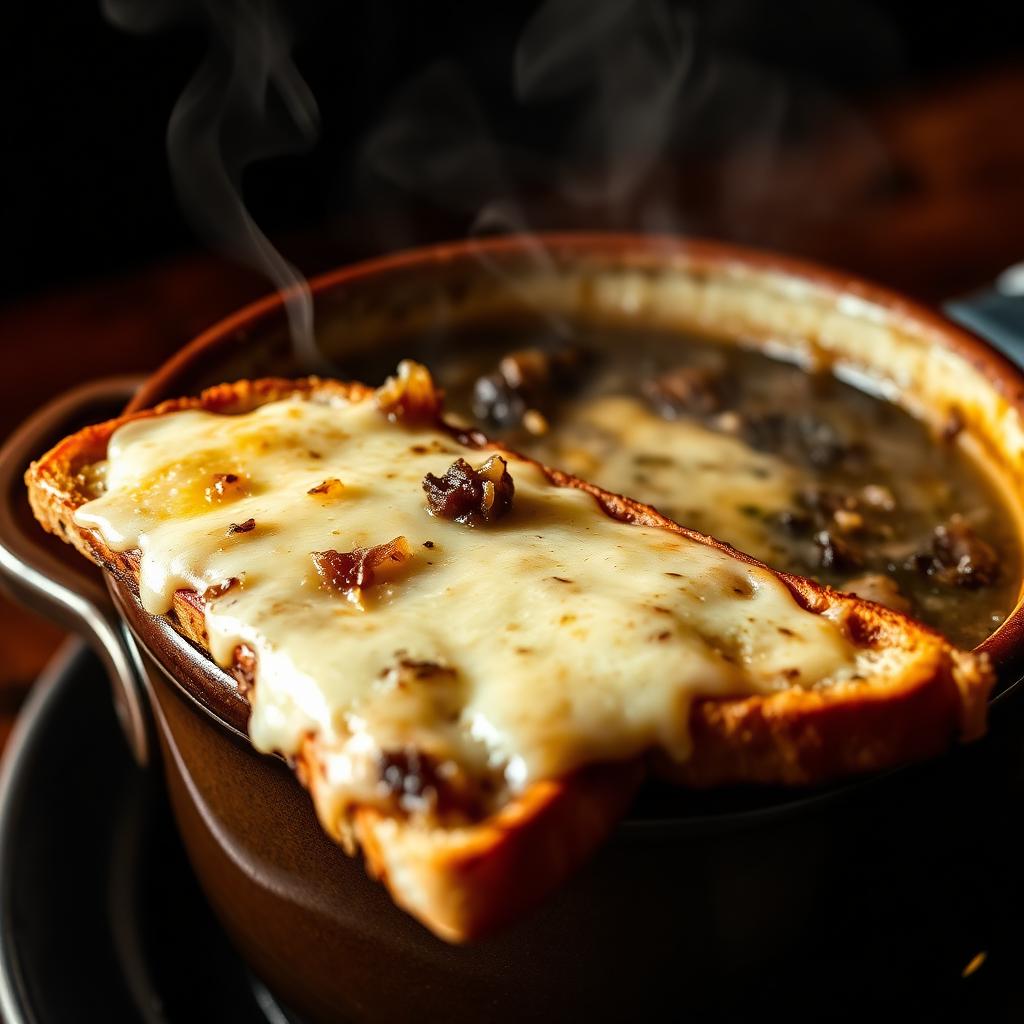
There is a specific kind of alchemy that happens when you commit to the slow, rhythmic dissolution of an onion. It is not a task for the hurried or the distracted. Making a proper French Onion Soup—the kind that clings to the back of a spoon and stretches in long, gooey ribbons of Gruyère—is an exercise in patience and sensory observation. You are looking for the moment when the sharp, volatile sting of the raw bulb gives way to a mellow, jammy sweetness, a transformation that takes place in the quiet hiss of a buttered pan. This version is my definitive take, honed through years of cold winters and a stubborn refusal to accept the thin, salty broths often served in bistros. It is a hearty, structural soup, fortified with bone broth and a splash of bright wine, topped with a crust of bread so substantial it requires a serrated edge and a bit of determination to break through. It is comfort in its most architectural form.
The story
Why this one stuck
My introduction to the true soul of an onion did not happen in a culinary school or a high-end restaurant, but in a drafty kitchen in the Jura Mountains during a particularly ferocious February. I was staying with a woman named Tante Marthe, a woman whose hands were permanently stained the color of walnuts from gardening and whose kitchen always smelled faintly of woodsmoke and dried herbs. She viewed the onion not as a pantry staple, but as a sacrifice. 'You must make them weep before they can sing,' she would say in French so thick with dialect I could barely parse it.
We spent an entire afternoon sitting by the hearth, my job being the thankless peeling and slicing of three heavy sacks of yellow onions. The air was thick enough to make my eyes burn, a constant prickling that felt like a penance. Marthe didn't use a timer. She used her ears and her nose. She taught me to listen for the change in the sizzle—the way the sound softens when the water has finally evaporated and the sugars start to catch. We watched the pot together as the sun dipped behind the pines, the onions shifting from a snowy white to a pale straw, then to a honeyed gold, and finally to a color she called 'the belly of a violin.'
There was no shortcutting the process. Whenever I tried to turn up the flame, she would gently rap my knuckles with a wooden spoon. 'L’impatience est l’ennemi du goût,' she’d mutter. Impatience is the enemy of taste. When the broth was finally added—a dark, viscous beef stock she’d started two days prior—the kitchen transformed. The sharp edge of the day softened. We ate those bowls standing up by the stove, the Gruyère stretching in long, defiant strings from our spoons to our chins. It wasn't just a meal; it was a fortification against the howling wind outside.
Every time I make this soup now, I am looking for that violin-belly color. I am looking for the smell of a French kitchen in the dead of winter, where time is measured not by seconds, but by the gradual darkening of a Dutch oven. This recipe is an attempt to capture that stillness. It requires you to stay put, to stir, to watch, and to wait. But when you finally break through that scorched crust of cheese and find the rich, umami-laden depths beneath, you realize Marthe was right. The wait is the most important ingredient. It is the only way to turn the humble, tear-inducing onion into something that feels like a velvet hug for the soul.
What you'll need
Ingredients
- 6 large Yellow Onions (about 3 lbs), halved and sliced 1/8-inch thick
- 4 tablespoons Unsalted Butter (preferably European style with high fat)
- 2 tablespoons Extra Virgin Olive Oil
- 1 teaspoon Granulated Sugar (to aid initial caramelization)
- 1 teaspoon Kosher Salt, plus more to taste
- 3 cloves Garlic, minced fine into a paste
- 2 tablespoons All-Purpose Flour (unbleached)
- 1/2 cup Dry White Wine (Sauvignon Blanc or Pinot Grigio)
- 6 cups High-Quality Beef Bone Broth (cold)
- 1 tablespoon Cognac or Dry Sherry (optional but encouraged)
- 2 sprigs Fresh Thyme, tied with butcher's twine
- 1 dried Bay Leaf
- 1 tablespoon Worcestershire Sauce
- 1/2 teaspoon Black Pepper, freshly cracked
- 8-12 slices French Baguette, cut 3/4-inch thick on a bias
- 12 ounces Gruyère Cheese, coarsely grated (roughly 3 cups)
- 2 ounces Parmigiano-Reggiano, finely grated
Step by step
How to make it
- 01
Begin by melting the butter and olive oil in a heavy-bottomed Dutch oven (Le Creuset or similar) over medium-low heat. The oil prevents the butter solids from scorching too early. Once the butter is foaming, add the mountain of sliced onions. They will fill the pot to the brim; do not panic, as they are mostly water and will soon surrender their volume. Toss them thoroughly with tongs to coat every strand in the fat.
- 02
Sprinkle the sugar and salt over the onions. This salt draws out the moisture via osmosis, while the sugar kickstarts the browning. Cover the pot with a tight-fitting lid for the first 15 minutes. This 'sweating' phase softens the cellular structure of the onions, allowing them to slump down into a translucent, tangled heap. Resist the urge to stir more than once during this period.
- 03
Remove the lid. Increase the heat to medium and begin the long, slow caramelization. Stir every 5 to 8 minutes. You are looking for 'fond'—the brown glaze that develops on the bottom of the pan. When you see it, scrape it up into the onions using a wooden spatula. If the pan looks too dry or the onions are catching too quickly, add a tablespoon of water to deglaze the surface. Repeat this for 45 to 60 minutes until the onions are a deep, uniform mahogany.
- 04
Add the minced garlic and cook for exactly 60 seconds until fragrant but not browned. Sprinkle the flour over the onions and stir vigorously for 2 minutes. This cooks out the raw starch flavor and creates a roux-like coating on the onions, which will eventually give the broth its silkiness. The mixture will look like a thick, dark paste at this stage. It should smell nutty and rich.
- 05
Pour in the white wine to deglaze the pot. Use your spatula to scrape every last bit of caramelized onion sugars from the bottom. Let the wine bubble and reduce by half, which concentrates the acidity and removes the harshness of the alcohol. This bright note is essential to prevent the soup from feeling too heavy or one-dimensional in its savoriness.
- 06
Gradually whisk in the cold beef broth. Starting with cold liquid helps the flour incorporate without clumping. Add the thyme bundle, bay leaf, Worcestershire sauce, and cracked pepper. Bring the liquid to a gentle simmer, then reduce the heat to low. Let it murmur uncovered for 30 to 40 minutes. This allows the flavors to marry and the broth to reduce slightly, intensifying the beefy backbone.
- 07
While the soup simmers, prepare the 'croûtes'. Preheat your oven to 350°F. Arrange the baguette slices on a baking sheet and bake for 5-7 minutes per side until they are completely dry and crisp, like oversized crackers. This 'staling' process is crucial; if the bread is soft, it will disintegrate into a soggy porridge the moment it hits the broth. Topping them with a rub of a raw garlic clove adds an extra layer of zing.
- 08
Remove the thyme and bay leaf from the soup. Stir in the Cognac or Sherry if using, and taste for seasoning. It may need a pinch more salt to make the onion flavors pop. Ladle the hot soup into oven-safe crocks, leaving about an inch of headspace at the top. The soup should be thick with onions, not just a thin broth with a few stragglers.
- 09
Place two toasted baguette slices on top of each bowl, overlapping them if necessary to cover the surface of the soup. Generously pile the grated Gruyère over the bread, ensuring it touches the edges of the bowl—this creates the burnt cheese 'skirt' that is so coveted. Sprinkle a dusting of Parmigiano-Reggiano over the top for a sharper, salty finish.
- 10
Arrange the crocks on a sturdy baking sheet and place them under the broiler, about 4-5 inches from the heating element. Watch them like a hawk. The cheese will bubble and blister, turning from pale yellow to a speckled tan, and finally to a deep sunset gold with charred spots. This usually takes 3 to 5 minutes. Remove carefully and let rest for 5 minutes before serving to avoid third-degree burns.
Cook's notes
Tips for your best result
- 01Patience is your primary tool. Do not try to caramelize three pounds of onions in twenty minutes. If you do, they will be bitter and burnt rather than sweet and tender. Expect the process to take at least an hour over medium-low heat.
- 02Use a heavy-bottomed pot. A thin pot will create hot spots that scorch the onions in some places while leaving them raw in others. Cast iron or enameled Dutch ovens distribute the heat evenly for a uniform caramelization.
- 03Don't skimp on the deglazing. The 'fond'—those brown bits stuck to the bottom of the pan—is where the concentrated flavor lives. Use your wine and eventually your broth to scrape every molecule of that flavor back into the liquid.
- 04The bread must be bone-dry. If you use fresh baguette, the soup will immediately turn it into a mushy paste. Toasting it until it’s hard throughout ensures it can support the weight of the cheese without sinking like the Titanic.
- 05Grate your own cheese. Pre-shredded cheeses are coated in potato starch or cellulose to prevent clumping, which prevents them from melting into that luxurious, cohesive layer of goo that defines this dish. Buy a block of cave-aged Gruyère.
- 06Season in stages. Add salt at the beginning to help the onions release water, but wait until the very end to do your final tasting. As the broth reduces, the saltiness will concentrate, so you don't want to overdo it early on.
Make it yours
Variations
While the French classic is a masterpiece of restraint, there are ways to tilt the flavor profile toward different horizons. For a more 'Forestier' style, you can add half a pound of sautéed cremini or shiitake mushrooms along with the onions; their earthy depth plays beautifully with the beef stock. If you prefer a vegetarian version, swap the beef broth for a dark, roasted vegetable stock and add a tablespoon of miso paste or soy sauce to provide the necessary umami that the beef usually provides. For a different cheese experience, try a blend of Gruyère and Comté for extra nuttiness, or even a bit of sharp white cheddar for a more aggressive bite. In the UK, a 'Cotswold' version often uses a thick slice of toasted sourdough and a mixture of Guinness and beef stock for a darker, slightly more bitter profile. If you want to lean into the sweetness, a splash of balsamic vinegar added during the final stages of caramelization can provide a jammy, acidic counterpoint to the salt. Some even prefer to add a pinch of star anise to the simmering broth, which doesn't make it taste like licorice but rather heightens the meaty perception of the beef.
Keep it fresh
Storage & make-ahead
The base of the soup actually improves with age. You can refrigerate the onion broth in an airtight container for up to 4 days. When ready to serve, reheat it on the stove until boiling. Do not add the bread or cheese until the moment of serving, as the toast must be fresh and the cheese freshly melted to maintain the textural contrast. If you have leftover soup that is already topped with cheese, it can be reheated in the oven, though the bread will be soft—delightful in its own way, like a savory bread pudding. Freezing the base is also an option; it will last for up to 3 months. Thaw overnight in the fridge before the final assembly and broiling. Avoid freezing the cheese-topped version, as the dairy and bread will not survive the crystalline structure of the freezer gracefully.
Reader questions
Frequently asked
Why does my soup taste sweet rather than savory and deep?
The secret lies in the Maillard reaction. Most recipes under-cook the onions, leaving them pale and sugary. You want them to collapse into a jam-like consistency that is the color of an old penny. This process releases complex sulfur compounds and sugars that provide the savory depth. If you rush this stage, the soup will taste like onion tea rather than a robust, fortified elixir. Give it the full hour.
Can I use different types of onions or should I stick to yellow?
Ideally, you want a mix. Yellow onions provide the backbone and the highest sulfur content for that classic bite. Adding a few red onions introduces a subtle earthy floral note, while shallots add a refined sweetness. Avoid using solely Vidalia or sweet onions, as their high sugar content can lead to a soup that is cloyingly sweet and lacks the structural bitterness required to balance the fat of the cheese.
My broth feels thin; how do I achieve that rich, velvety mouthfeel?
A true French Onion soup relies on the gelatinous mouthfeel of a high-quality beef stock. If you use store-bought, look for 'low sodium' and 'bone broth' labels. You can enhance a mediocre stock by simmering it for twenty minutes with a handful of dried porcini mushrooms or a tablespoon of soy sauce. This adds the 'umami' weight that the soup needs to stand up to the heavy cap of melted Gruyère.
Is the wine strictly necessary, and what kind should I use?
A dry, mineral-heavy white wine like a Sauvignon Blanc or a sharp Pinot Grigio works wonders to cut through the richness. However, for a more traditional, monastic depth, a dry Sherry or even a splash of Vermouth can be used. Avoid anything oaked, like a buttery Chardonnay, as the heat can turn those oak notes into something unpleasantly metallic and bitter when reduced with the onions.
What if I do not own oven-safe lion-head bowls or crocks?
Absolutely. If you don't have oven-safe crocks, you can toast the baguette slices topped with cheese on a baking sheet until they are bubbling and gold. Place them carefully on top of the bowls just before serving. However, you will miss the 'ooze' factor where the cheese fuses with the rim of the bowl, creating those chewy, caramelized bits that many consider the best part of the meal.