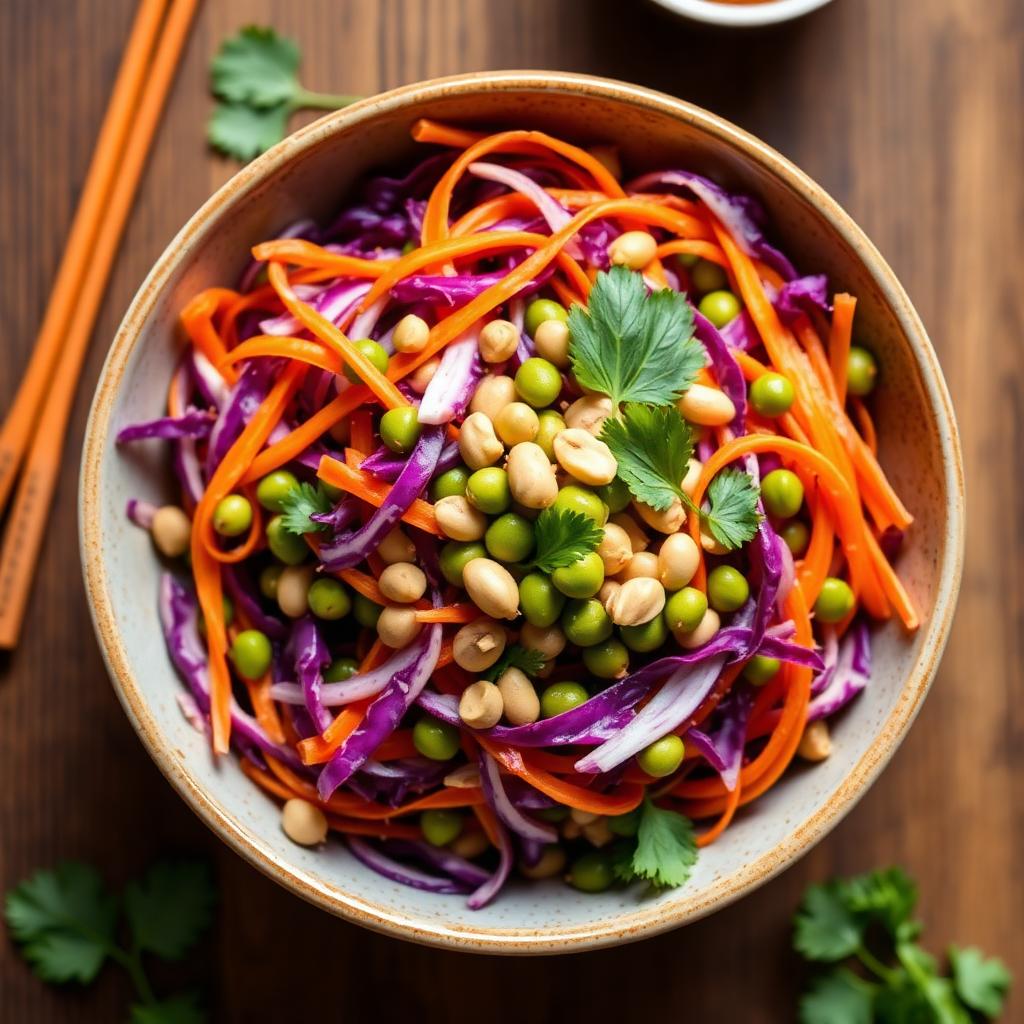
There is a specific kind of alchemy that happens when the structural integrity of raw, crisp vegetables meets the unapologetic richness of a well-balanced peanut sauce. This isn't just a salad; it is a study in friction and relief. Most slaws feel like an afterthought, a dutiful pile of fiber sitting alongside a main protein, but this version demands center stage. It is loud, it is bright, and it possesses a textural complexity that keeps the palate perpetually interested. We are leaning into the cooling properties of Napa cabbage and fresh mint, then anchoring them with a dressing that feels more like a savory silk than a condiment. It’s the kind of dish that makes you forget that 'healthy' and 'soul-satisfying' were ever intended to be mutually exclusive concepts. Whether you’re serving this as a base for grilled shrimp or eating it straight from the mixing bowl standing over the kitchen sink, it delivers a visceral, crunchy satisfaction that lingers long after the bowl is empty.
The story
Why this one stuck
My relationship with this slaw began not in a kitchen, but in the humid, salt-slicked air of a tiny back-alley apartment in Macau, where my Aunt June lived during the late nineties. June wasn't a biological aunt, but rather a woman who had survived three shipwrecks and two marriages, and who possessed a laugh that could shatter fine china. Her kitchen was the size of a telephone booth, smelling perpetually of toasted sesame and old newsprint. While the rest of the city was obsessed with the precision of Portuguese egg tarts or the heavy richness of pork chop buns, June was a devotee of the 'raw and the loud.'
I remember sitting on a plastic milk crate, the floor sticky with high-summer condensation, watching her work. She didn't use a knife for the cabbage; she used a rusted, terrifyingly sharp cleaver that she wielded with the grace of a cellist. She would talk about her life in fragments—the years spent in San Francisco, the months on a fishing boat near Hokkaido—and all the while, the rhythmic *thwack-thwack-thwack* of the blade against the wooden board created a soundtrack to her autobiography.
She taught me that a peanut dressing is only as good as its acidity. 'People treat peanut butter like a blanket,' she’d say, tossing a handful of lime wedges into my lap for squeezing. 'They use it to hide the vegetables. No. You use the peanut to make the vegetables scream.' She’d whisk the paste until it was nearly white, then dark with tamari, her eyes darting between the bowl and the street life visible through the open door.
We would eat the slaw out of chipped ceramic bowls, using our fingers to fish out the last of the crushed peanuts. It was a sensory overload—the heat of the city pressing in, the sting of the ginger on my tongue, and that incomparable, deafening crunch of the Napa cabbage. June is gone now, but every time I smell ginger and lime, I am back on that milk crate. I’ve refined the measurements over the years, substituting her 'handful of this' for precise tablespoons, but the spirit remains the same. It is a dish born of heat and humidity, designed to wake up a tired body. It is a legacy of resilience, chopped fine and dressed in velvet. Whenever I make this, I make it with a heavy hand on the lime, just the way she would have demanded, ensuring that the vegetables never hide, but instead, they sing.
What you'll need
Ingredients
- For the Peanut Lime Dressing
- 1/2 cup creamy natural peanut butter (the kind you have to stir)
- 3 tablespoons fresh lime juice (about 1.5 large limes)
- 2 tablespoons unseasoned rice vinegar
- 2 tablespoons tamari or low-sodium soy sauce
- 1 tablespoon honey or maple syrup
- 1 tablespoon toasted sesame oil
- 1 tablespoon freshly grated ginger (use a microplane for a pulp-like consistency)
- 1 large clove garlic, finely minced into a paste
- 1/2 teaspoon sambal oelek or sriracha (optional, for a subtle hum)
- 1-2 tablespoons warm water to thin to desired consistency
- For the Slaw Base
- 1 small head Napa cabbage (about 1 pound), shredded thin crosswise
- 2 cups purple cabbage, very finely sliced into ribbons
- 2 large carrots, julienned or shredded on a box grater
- 1 red bell pepper, sliced into matchsticks the size of a toothpick
- 1 cup sugar snap peas, sliced thinly on a sharp diagonal
- 3 scallions, white and light green parts only, bias-cut into thin rounds
- 1/2 cup fresh cilantro leaves, roughly chopped
- 1/2 cup fresh mint leaves, torn by hand just before serving
- 1/2 cup roasted salted peanuts, roughly crushed for garnish
- 1 tablespoon black or toasted white sesame seeds
Step by step
How to make it
- 01
Begin by making the dressing in a medium glass bowl. Whisk together the peanut butter, lime juice, rice vinegar, tamari, and honey. It will likely look curdled and broken at first; do not panic. This is the chemistry of fats and acids fighting for dominance. Continued whisking will bring them into a smooth, emulsified submission.
- 02
Add the sesame oil, grated ginger, minced garlic paste, and your choice of chili paste. Whisk vigorously until the dressing takes on a glossy, satin sheen. If it feels too stubborn or thick to drizzle, whisk in warm water one teaspoon at a time until it reaches the consistency of heavy cream. Set this aside to allow the aromatics to bloom.
- 03
Prepare your Napa cabbage by removing any bruised outer leaves. Slice the head in half lengthwise, then slice crosswise into 1/4-inch ribbons. As you get toward the sturdier base, slice even thinner to ensure the texture remains delicate. Toss these into your largest mixing bowl.
- 04
Tackle the purple cabbage with a mandoline if you have one, or a very sharp chef's knife. We want thin, translucent wisps that add color without being overly fibrous or difficult to chew. Add this to the Napa cabbage.
- 05
Julienne your carrots and red bell pepper. Aim for uniform matchsticks; the architectural integrity of this salad depends on the vegetables having a similar shape so they can intertwine rather than stacking awkwardly like cordwood.
- 06
The sugar snap peas should be sliced on a steep diagonal. This exposes their sweet inner peas and creates more surface area for the dressing to cling to. Combine these with the cabbage and peppers.
- 07
Add the sliced scallions and the roughly chopped cilantro to the vegetable mound. Using your hands or two large spoons, toss the vegetables together until the colors are evenly distributed—a kaleidoscope of jade, amethyst, and ochre.
- 08
Just before serving, pour about two-thirds of the dressing over the vegetables. Massage the dressing into the cabbage gently; this isn't a kale salad that needs bruising, but a light coating ensures every crevice is reached. Add more dressing as needed, but avoid drowning the ingredients; we want a lacquer, not a soup.
- 09
Scatter the torn mint leaves over the top. Mint oxidizes quickly when cut with a knife, so tearing it ensures it stays bright and fragrant for the duration of the meal.
- 10
Finish the dish by showering it with the crushed peanuts and sesame seeds. These provide the final, high-decibel crunch that defines the dish. Give it one final, very light toss and serve immediately in a wide, shallow bowl.
Cook's notes
Tips for your best result
- 01Use cold water to wash your cabbage, then dry it with aggressive thoroughness. Water is the enemy of this dressing; even a small amount of residual moisture on the leaves will dilute the flavors and turn the sauce from creamy to watery in a matter of minutes.
- 02When grating your ginger, do not peel it with a knife. Use the edge of a small spoon to scrape away the skin; this allows you to follow the irregular contours of the root without wasting the potent flesh directly underneath the peel. Using a microplane ensures the ginger integrates into the liquid rather than leaving woody clumps.
- 03If your peanut butter is from the bottom of the jar and feels particularly dry or chalky, add an extra teaspoon of sesame oil. This replaces the natural oils that often migrate to the top of the jar, ensuring the dressing retains its signature glide.
- 04Don't skip the mint. While cilantro provides a familiar herbal base, the mint acts as a cooling agent that cuts through the fattiness of the peanuts and the heat of the ginger. It is the secret ingredient that transforms the dish from 'good' to 'transformative.'
- 05For the professionally minded, chill your serving bowl in the freezer for ten minutes before tossing. A cold bowl helps maintain the cell structure of the cabbage, keeping the crunch at its maximum decibel level for the duration of the meal.
Make it yours
Variations
This slaw is a chameleon, capable of shifting its identity to suit your pantry or your protein. For a more substantial meal, I often add cold, shredded rotisserie chicken or poached shrimp, which soak up the peanut dressing with enthusiasm. If you find yourself craving something more substantial than a side dish, toss in a handful of chilled soba noodles or thin rice vermicelli; they provide a soft, chewy counterpoint to the relentless crunch of the cabbage. For an extra layer of complexity, try adding thinly sliced green mango or under-ripe papaya for a tart, tropical edge that mimics a traditional Som Tum. If you want to increase the heat, a finely diced bird’s eye chili will provide a sharp, clean burn that lingers beautifully. For those who enjoy a bit of smokiness, replacing the roasted peanuts with smoked almonds creates a fascinating depth of flavor that pairs exceptionally well with grilled flank steak. Finally, if you are looking to make this visually stunning for a dinner party, use an equal mix of purple and green cabbage to create a high-contrast tapestry that practically vibrates on the plate.
Keep it fresh
Storage & make-ahead
If you are a strategist like me, you will keep the components separate. The dressing will live happily in a sealed jar in the refrigerator for up to five days; just be sure to let it come to room temperature and give it a vigorous shake before using, as the peanut oils will firm up when cold. The vegetable mix (minus the fresh herbs) can be prepped and stored in a glass container with a damp paper towel draped over the top to maintain turgidity for about 48 hours. However, once the lime juice and salt in the dressing meet the cabbage, the clock starts ticking. Leftovers will lose their structural 'snap' by the next morning, turning into something more akin to a cold marinated noodle dish. It’s still flavorful, but the magnificent crunch will be a memory. To revive day-old slaw, I often toss in a handful of fresh, dry cabbage or extra peanuts to reintroduce that lost texture.
Reader questions
Frequently asked
Can I substitute Napa cabbage for regular green cabbage?
While Napa cabbage offers a delicate, frilly sweetness, you can certainly substitute it with standard green cabbage. However, because green cabbage is denser and more rigid, I recommend slicing it paper-thin and perhaps giving it a very light sprinkle of salt and a five-minute rest before tossing. This 'wilts' the structural fibers just enough to ensure it doesn't feel like you are chewing through raw garden mulch, while still retaining that essential snap.
Why does my peanut dressing get so thick and pasty?
Natural, drippy peanut butter is the secret to a dressing that feels elegant rather than industrial. If you use the highly processed brands stabilized with palm oil and sugar, the dressing may seize up into a thick, clay-like paste when the lime juice hits it. The natural oils in the separated style emulsify far more gracefully with the rice vinegar and tamari, resulting in a lacquer-like finish that coats the vegetables without clumping.
Is this recipe vegan-friendly?
You can absolutely make this recipe vegan by swapping the honey for agave nectar or a simple brown sugar syrup. The fish oil component often found in Asian-style dressings is already absent here, as we rely on the deep, fermented richness of tamari and the earthy weight of toasted sesame oil to provide the umami backbone. It is a seamless transition that preserves the integrity of the flavor profile.
The raw garlic feels a bit too aggressive; how can I tone it down?
The raw garlic and ginger are potent aromatics that continue to release their volatile oils as they sit in the acidic environment of the dressing. If you find the bite too sharp, you can 'mellow' the aromatics by whisking them into the lime juice and vinegar first and letting them macerate for ten minutes before adding the peanut butter. This tempers the sulfurous sting of the garlic while keeping its foundational flavor.
How long can the slaw sit out once it has been dressed?
The dressed slaw will hold its integrity for about two hours at room temperature, making it ideal for a buffet or a long dinner. Beyond that, the salt in the dressing will begin to draw out the cellular moisture of the cabbage, leading to a pool of liquid at the bottom of the bowl. For the best sensory experience, keep the components separate until thirty minutes before you intend to serve.
What can I use if I have a peanut allergy?
If you have a nut allergy, toasted sunflower seed butter (sunbutter) is a miraculous substitute. It has a similar earthy depth and high fat content that carries the lime and ginger beautifully. Tahini is another option, though it introduces a more bitter, Mediterranean profile that may require a touch more honey to balance. Avoid using almond butter here, as it tends to be too grainy for this specific application.