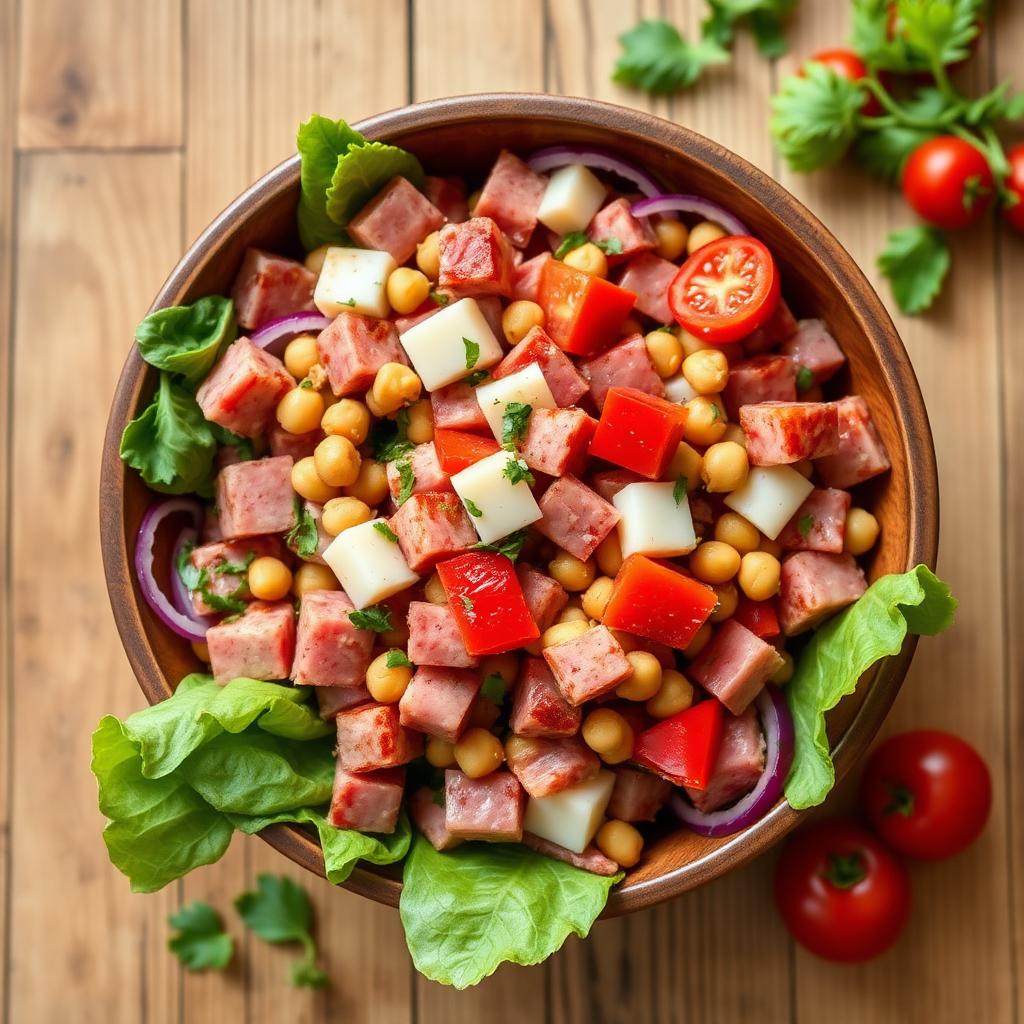
There is a specific, frantic geometry to a true Italian Chopped Salad. It is not the loose, leafy heap of greens that arrives as an afterthought at a steakhouse. No, this is a calculated architectural feat. It’s about the 'shred'—that precise, narrow ribboning of romaine and radicchio that creates a tangled nest for heavy jewels of salami, sharp provolone, and brine-soaked peppers. In this kitchen, we treat the chopping not as a chore, but as a ritual of texture. When you get it right, every forkful is a microcosm of the whole: the bitter snap of the radicchio, the creamy fat of the cheese, and the electric, jagged edge of a red wine vinaigrette that has been emulsified to the point of velvet. We aren't just making a salad; we are building a sensory experience that demands your full attention, a dish that manages to be both incredibly rugged and obsessively manicured. It is bright, loud, and unapologetically bold.
The story
Why this one stuck
In the late nineties, there was a basement trattoria in the North End of Boston called 'Enzo’s'—a place so cramped that the waiters had to breathe in to pass each other between the vinyl-clad tables. My Great Aunt Filomena didn’t work there, but she haunted the kitchen like a benevolent, flour-dusted ghost. She was a woman who believed that a knife was an extension of the soul, and she watched the prep cooks with a hawk-like intensity that could make a grown man drop his pairing knife.
Filomena taught me that a salad is a test of character. 'Anyone can throw a leaf in a bowl,' she’d rasp, her voice a low crackle from decades of unfiltered Chesterfields. 'But a chop? A chop requires discipline.' She would sit me down with a mountain of radicchio—that stubborn, bitter orb—and tell me to slice it so thin it looked like confetti for a funeral. She hated the 'clunky' salads of the suburbs, the ones with giant wedges of watery iceberg and thick slabs of rubbery carrot. To her, those were an insult to the digestive system.
I remember the smell of that basement kitchen vividly: a thick, humid fog of boiling pasta water, fermented yeast, and the sharp, nose-tickling sting of red wine vinegar hitting the air. Filomena’s vinaigrette wasn't measured in tablespoons; it was measured in 'counts' and 'feels.' She’d make the dressing in a cracked ceramic pitcher, whisking with a fork until her forearm muscles stood out like corded rope. She insisted on using the dried oregano that her cousin sent from Sicily, still on the woody stalks, which she would pulverize between her palms until the room smelled like a baked hillside.
One sweltering August afternoon, she stood over me as I prepped the salami. 'Consistency, child! If the cheese is a square and the meat is a circle, they will never dance together on the fork!' This was her philosophy: the uniformity of the chop wasn't for aesthetics; it was for the physics of the bite. You wanted a bit of everything—the salty meat, the sharp cheese, the bitter green, the acidic onion—to hit the tongue at the exact same millisecond.
When Enzo eventually closed its doors and the basement was turned into a trendy wine bar with 'industrial' lighting and no soul, Filomena retreated to her small apartment above a bakery. But the salad stayed. It became the dish I made when I needed to feel grounded, when the world felt too chaotic and I needed to exert control over something, even if it was just the size of a cucumber dice. Every time I hear the rhythmic 'thwack-thwack' of my chef’s knife against the board, I feel her presence. This recipe is an inheritance, a piece of that humid Boston basement, and a reminder that there is a profound, quiet beauty in the way we prepare our food for those we love. It is loud, it is vinegar-forward, and it refuses to be ignored—just like Filomena.
What you'll need
Ingredients
- For the Red Wine Vinaigrette
- 1/2 cup high-quality aged red wine vinegar
- 1 tablespoon dried Sicilian oregano (crushed between palms) magnifying the aroma
- 2 teaspoons Dijon mustard (the emulsifier)
- 1 large garlic clove, turned into a paste with a pinch of salt
- 1/2 teaspoon granulated sugar (to balance the acidity)
- 3/4 cup extra-virgin olive oil (cold-pressed) personal preference for Piqual or Frantoio
- 1/2 teaspoon flaky sea salt and cracked black pepper to taste
- For the Salad Base
- 1 large head Romaine heart, sliced into 1/4-inch ribbons
- 1 small head Radicchio, cored and finely shredded into ribbons
- 1 cup canned chickpeas, rinsed, patted dry, and skins removed if you are a perfectionist
- 4 ounces Genoa salami, cut into 1/4-inch batons
- 4 ounces Sharp Provolone or Fontina cheese, cut into 1/4-inch cubes
- 1/2 cup Persian cucumbers, quartered and sliced into small triangles
- 1/2 cup cherry tomatoes, quartered and deseeded to prevent sogginess
- 1/3 cup pitted Castelvetrano olives, roughly chopped for a buttery saltiness
- 1/4 cup pickled Peppadew peppers or pepperoncini, thinly sliced into rings
- 1/4 red onion, shaved into paper-thin half-moons and soaked in ice water for 10 minutes
- 1/2 cup fresh flat-leaf parsley, coarsely chopped
Step by step
How to make it
- 01
Begin with the structural architecture of the vinaigrette. In a small glass jar or a stainless steel bowl, combine the aged red wine vinegar, the garlic paste, and the Dijon mustard. Whisk these together until they form a cohesive, cloudy liquid. This foundation ensures the oil will stay suspended rather than separating into greasy pockets later.
- 02
Take your dried oregano and place it in the center of your palm. Use your other thumb to grind the herb in a circular motion until it smells like a sun-drenched hillside in Calabria. Whisk this into the vinegar base along with the sugar, salt, and a generous amount of cracked black pepper. Let this sit for five minutes to hydrate the herbs.
- 03
Slowly stream in the extra-virgin olive oil while whisking vigorously. You are looking for a physical change—the dressing should thicken slightly and take on a matte, opaque appearance. Once emulsified, taste it using a piece of the Romaine you intend to use. It should be punchy and bright. Set aside at room temperature.
- 04
Prepare the greens with surgical precision. For the Romaine, slice the head lengthwise, then crosswise into narrow ribbons. For the radicchio, remove the bitter white core first, then shred as finely as you would a cabbage for slaw. Toss these two together in an oversized bowl; the ratio should be roughly three parts green to one part purple.
- 05
Address the moisture-heavy vegetables. Slice your cucumbers and tomatoes, then place them in a small colander over the sink with a pinch of salt for 5 minutes. This 'sweating' process ensures that the water inside the vegetables doesn't dilute your dressing once the salad is tossed.
- 06
Drain the red onions from their ice water bath and pat them completely dry with a lint-free kitchen towel. This soaking step removes the sulfurous 'burn' of the raw onion, leaving behind only the crisp texture and a mild, sweet allium flavor that won't haunt you for the rest of the afternoon.
- 07
Combine the 'heavy hitters.' Add the chickpeas, salami batons, cubed cheese, olives, and pickled peppers to the bowl of greens. Using your hands, toss these ingredients together. Using hands allows you to feel the distribution—you want to ensure that no clump of salami or pocket of cheese is left isolated at the bottom of the bowl.
- 08
Add the sweated cucumbers and tomatoes to the mix. Just before serving, give the vinaigrette one last vigorous shake or whisk. Drizzle half of the dressing over the salad and toss using large tongs or two large spoons, lifting from the bottom and folding over the top.
- 09
Observe the greens. They should look glossy and 'dressed,' but not swimming in liquid. Add more dressing one tablespoon at a time if necessary. You are seeking a state where every ribbon of lettuce has a microscopic coating of oil and vinegar.
- 10
Transfer the salad to a chilled platter. Finish with a final flourish of chopped parsley and an extra pinch of oregano. Serve immediately while the lettuce is at its peak 'snap' and the cheese is still firm against the acidic backdrop of the dressing.
Cook's notes
Tips for your best result
- 01The ice water bath for the red onions is a non-negotiable step; it leaches out the propanethial S-oxide, the gas that causes both tears and that lingering 'oniony' aftertaste.
- 02Pat your chickpeas dry between two paper towels until they are matte; if they are wet, the dressing will slide right off them and pool at the bottom of the bowl.
- 03Use a sharp serrated knife for the tomatoes; it allows you to saw through the skin without crushing the delicate interior, keeping the edges of your chop clean.
- 04Emulsifying the dressing in a jar by shaking it is more effective than whisking if you want a truly thick, creamy texture that won't separate quickly.
- 05The order of operations matters: dress the salad in a bowl much larger than you think you need to allow for proper aeration and even distribution of the vinaigrette.
- 06Salt your cucumbers and tomatoes separately as mentioned in the instructions; this 'pre-seasoning' draws out water and intensifies their natural flavor profile.
Make it yours
Variations
For a vegetarian interpretation that doesn't sacrifice the savory 'umami' of the salami, substitute the meat with smoked sun-dried tomatoes or marinated artichoke hearts. The smoky depth of the tomatoes mimics the cured meat profile surprisingly well. If you crave a more 'Cal-Ital' aesthetic, you might add thinly shaved fennel or blanched asparagus spears, though Purists like Filomena might scoff. For those who enjoy a bit of heat, doubling the amount of pickled peppers or adding a teaspoon of Calabrian chili paste to the vinaigrette adds a slow, creeping warmth that balances the coolness of the cucumbers. To make this vegan, swap the provolone for a high-quality almond-based feta and use a dash of tamari in the dressing to replace the salty depth of the cheese. Another favorite variation involves swapping the Romaine for lacinato kale; if you do this, be sure to 'massage' the kale with a little salt and lemon juice ten minutes before adding the other ingredients to break down the tough fibers. Finally, for a crunchier, more assertive texture, toasted pine nuts or crushed Marcona almonds can be scattered over the top just before serving.
Keep it fresh
Storage & make-ahead
This salad is a fleeting beauty; once the dressing is applied, the clock starts ticking toward wilted leaves. However, if you have leftovers, the marinated chickpeas and meats will actually taste better the next day. If you plan to eat this over several days, keep the 'wet' ingredients (cucumbers, tomatoes, and dressing) in separate containers from the 'dry' greens and meats. The vinaigrette itself will keep in a sealed jar in the refrigerator for up to two weeks; just be sure to bring it to room temperature and give it a violent shake before using, as the olive oil will solidify when chilled. The chopped salami and cheese can be prepped 24 hours in advance and kept in an airtight bag. Avoid freezing any component of this salad, as the high water content of the vegetables will turn to mush upon thawing.
Reader questions
Frequently asked
What makes this different from a standard tossed house salad?
The secret lies in the 'shred.' Most people leave their lettuce in large, floppy leaves, but for a true Italian chopped salad, the radicchio and romaine must be sliced into thin ribbons that act as a net for the heavier bits like chickpeas and salami. Additionally, salting the cucumbers and tomatoes separately to draw out excess moisture prevents the salad from becoming a puddle at the bottom of the bowl.
Can I make this salad ahead of clinical or dinner parties?
While you can certainly chop everything a few hours ahead of time, the golden rule is to keep the dressing separate until the very last second. Once the red wine vinaigrette hits the greens, the salt starts breaking down the cell walls of the lettuce, leading to a limp texture. If you are meal prepping, layer the heavy ingredients like chickpeas and meats at the bottom and the greens on top.
I don't have radicchio or fontina; what are the best substitutions?
Authenticity in a chopped salad is less about a rigid list of ingredients and more about the balance of flavor profiles: bitter, salty, fatty, and bright. If you despise olives, swap them for capers or pickled peppers. If radicchio is too assertive for your palate, try endive or curly kale. The essential part is maintaining the uniform size of the chop so the structural integrity remains intact.
Why does my vinaigrette taste too sharp or metallic?
High-quality red wine vinegar is non-negotiable. Look for one that has been aged in oak barrels if possible; it provides a mellow, complex acidity rather than a harsh, stinging bite. Many supermarket brands are essentially dyed white vinegar. Spending an extra few dollars on a premium vinegar like Volpaia or a similar Italian import will fundamentally change the character of your dressing.
Is there a trick to using dried oregano in the dressing?
Standard dried oregano can sometimes taste like dust, but dried oregano 'on the branch' or high-quality Sicilian dried oregano has an essential oil content that survives the drying process. To wake it up, rub the dried leaves vigorously between your palms directly over the dressing bowl. This friction creates just enough heat to release the oils, providing that nostalgic pizzeria aroma.
Is Romaine the only lettuce that works for this specific texture?
Not at all. While Romaine provides the structural crunch, you can use any sturdy green. Arugula adds a peppery bite, and Little Gem lettuce offers a buttery sweetness. Avoid delicate greens like mache or butter lettuce, as they lack the 'backbone' needed to stand up to the weight of the meats and cheeses and will wilt immediately under the pressure of the chop.