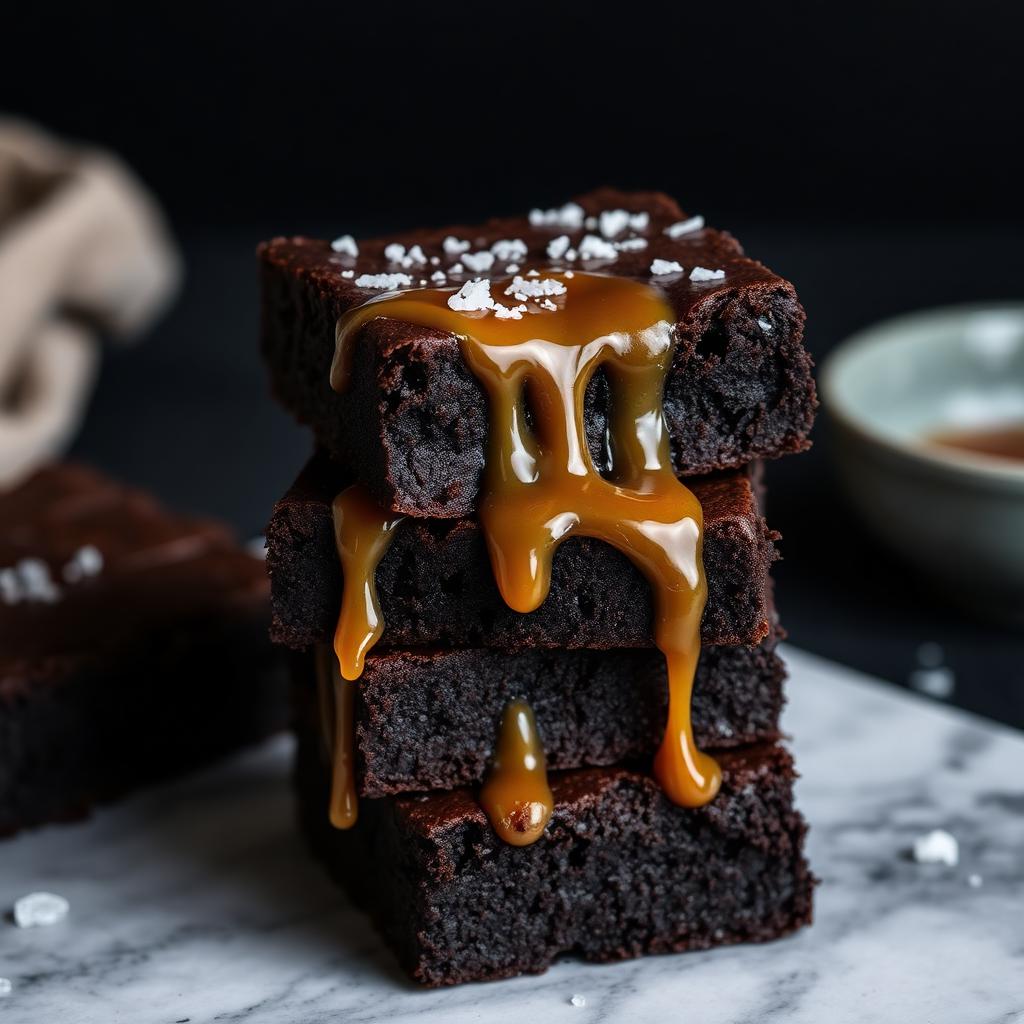
There is a specific kind of alchemy that happens when sugar is pushed to the very edge of its existence. It’s the moment just before the sweetness turns to smoke, a threshold where the flavor becomes sophisticated, brooding, and entirely transformative. These Salted Caramel Fudge Brownies are built upon that threshold. They are not the airy, cake-like squares found at bake sales; they are dense, unapologetically rich, and possess a structural integrity that demands your full attention. We are layering a bespoke, dry-burned caramel—rich with the minerals of flaky sea salt—into a base of browned butter and 70% dark chocolate. The result is a dessert of contradictions: it is bitter and sweet, shattering and molten, humble in appearance but regal in its depth. This is baking as an act of patience, a slow-motion collision of textures designed for those who find solace in the darker corners of the pantry.
The story
Why this one stuck
Thirteen years ago, I lived in a flat in Edinburgh that smelled perpetually of damp stone and expensive tobacco. My kitchen was a hallway with an oven that had two settings: 'off' and 'cremate.' It was there, during a winter so gray it felt like living inside a charcoal drawing, that I met Elara. She was a woman of eighty who lived three floors down and possessed an uncanny ability to know exactly when someone’s spirit was flagging. She didn’t offer platitudes; she offered jars of caramel.
Elara’s caramel wasn’t the pale, cloying stuff from a plastic squeeze bottle. It was dark, nearly the color of mahogany, and it had a bite to it. She called it 'the burnt offering.' One Tuesday, as the sleat hammered against the leaded glass, I arrived at her door with a bar of the darkest chocolate I could find and a desperate need for a hobby that didn't involve staring at the rain. Together, we sat in her cramped kitchen, watching sugar transform in a copper pot. She taught me that the secret to the best things in life—love, career, and certainly caramel—usually involves knowing exactly when to stop before everything turns to ash.
These brownies are a recreation of the first thing we ever baked together. We didn't have a whisk; we used a heavy silver fork. We didn't have a timer; we listened to the way the butter hissed in the pan. The brownie base had to be robust enough to carry the weight of her caramel, so we browned the butter until the milk solids were almost black, creating a savory bridge to the salt she insisted on throwing in by the handful. When we finally pulled the pan from that temperamental oven, the kitchen was filled with a scent so thick you could almost chew it. We ate them hot, the caramel burning our tongues, laughing at our own impatience.
Every time I make these now, I am back in that drafty hallway, watching the sugar crystals vanish into a golden liquid. It’s a recipe for the weary, for the ones who need a reminder that bitterness can be a beautiful thing when it's balanced by enough grace. It isn't just about the chocolate or the salt; it’s about the stillness of waiting for the perfect shade of amber. This is a recipe for long winters and old friends.
What you'll need
Ingredients
- For the Salted Caramel
- 200g Granulated white sugar
- 90g Unsalted high-fat European butter, cubed and room temperature
- 120ml Heavy cream (36% milkfat), warmed slightly
- 1 tsp Maldon sea salt flakes
- 1 tsp Pure vanilla bean paste
- For the Brownie Base
- 225g Unsalted butter, browned until nutty
- 250g Dark chocolate (70% cocoa solids), finely chopped
- 3 Large eggs, room temperature
- 200g Dark muscovado sugar, packed
- 100g Granulated white sugar
- 1 tbsp Espresso powder
- 1 tsp Fine sea salt
- 60g Dutch-process cocoa powder, sifted
- 125g All-purpose flour, spooned and leveled
- 150g Semisweet chocolate chunks (optional, for folding)
Step by step
How to make it
- 01
Begin with the caramel. In a heavy-bottomed stainless steel saucepan, spread the 200g of granulated sugar in an even layer. Melt over medium heat without stirring. As the edges begin to liquify and turn amber, gently drag the crystals toward the center with a heat-proof spatula. Once fully melted and the color of an old penny, remove from heat immediately to prevent burning.
- 02
Whisk the 90g of cubed butter into the amber sugar. It will bubble violently; this is normal. Continue whisking until the fat is fully incorporated and the mixture is smooth. Slowly pour in the warmed heavy cream in a steady stream, whisking constantly. Return to low heat for 1 minute to ensure total homogeneity. Stir in the Maldon salt and vanilla bean paste. Pour into a glass jar and set aside to cool to a thick, pourable consistency.
- 03
Preheat your oven to 350°F (175°C). Line an 8x8-inch square metal baking pan with overhanging parchment paper, creating a 'sling' for easy removal later. Avoid glass pans, as they retain heat too efficiently and can results in overbaked, dry edges before the center is set.
- 04
Brown the butter for the brownies. Place the 225g of butter in a light-colored skillet over medium heat. Melt, then continue cooking as it foams and pops. Once the milk solids have turned a deep toasted hazelnut color and the aroma is intensely nutty, remove from heat. Immediately stir in the 250g of chopped dark chocolate. Let it sit for 2 minutes, then whisk until the mixture is a glossy, liquid ebony.
- 05
In a large mixing bowl, combine the three eggs, dark muscovado sugar, granulated sugar, and espresso powder. Using a whisk or an electric hand mixer on medium-high speed, beat the mixture for full 4-5 minutes. You are looking for the 'ribbon stage'—where the mixture is pale, tripled in volume, and leaves a visible trail when the whisk is lifted. This aeration is the secret to the crackly top.
- 06
Slowly stream the butter-chocolate mixture into the aerated eggs while whisking on low speed. Be gentle; you want to preserve the air you've just incorporated while ensuring no streaks of egg remain. The batter should look like heavy velvet at this stage.
- 07
Switch to a flexible silicone spatula. Sift the cocoa powder, flour, and fine sea salt directly over the wet ingredients. Fold the dry ingredients in using a 'cutting and lifting' motion—cut through the center, scrape the bottom, and lift over. Stop the moment the last white streak of flour disappears. If using chocolate chunks, fold them in now with two quick turns.集中。
- 08
Pour roughly two-thirds of the brownie batter into the prepared pan, smoothing it into the corners. Take your cooled (but still liquid) caramel and drizzle about 3/4 of it over the batter in thick, horizontal lines. Use a knife to lightly swirl the caramel, but do not over-mix; you want distinct pockets. Pour the remaining brownie batter over the top, then finish with the remaining caramel in small decorative dots.
- 09
Bake for 32-35 minutes. At the 30-minute mark, check the pan. The edges should be slightly puffed and matte, while the center should still have a very slight wobble. Do not overbake; the residual heat will finish the job. If a toothpick comes out with wet batter, it needs 2 more minutes. If it comes out with moist crumbs, it is perfect.
- 10
Remove from the oven and immediately sprinkle an extra pinch of Maldon salt over the top. Allow the brownies to cool completely in the pan for at least 4 hours, or preferably overnight in the refrigerator. This rest period is non-negotiable; it allows the caramel to set and the chocolate's complex fats to re-solidify into a fudgy texture. Use the parchment sling to lift the block out and slice with a hot, clean knife.
Cook's notes
Tips for your best result
- 01Use a light-colored pan to melt your sugar and brown your butter. If the pan is black, you won't be able to accurately judge the color change, and you’ll likely end up with actually burnt, bitter results rather than perfectly caramelized ones.
- 02When browning your butter, don't walk away. It goes from 'golden and fragrant' to 'burnt and ruined' in about fifteen seconds. Watch for the foam to subside; that’s when the browning of the milk solids truly begins. 集中。
- 03Heat your cream before adding it to the hot sugar. If you pour cold cream into 350-degree sugar, the thermal shock will cause the sugar to seize into a hard, crystalline rock that is incredibly difficult to melt back down. 集中。
- 04The 'ribbon stage' for your eggs and sugar is the difference between a flat, greasy brownie and one with a beautiful, crackly top. Don't rush this step; the air trapped in the egg foam provides the only lift this recipe gets. 集中。
- 05Always use high-quality chocolate bars rather than chocolate chips for the base. Chips contain stabilizers like soy lecithin that prevent them from melting into the smooth, homogenous pool required for a truly fudgy texture. 集中。
- 06If you have the patience, let the sliced brownies sit uncovered on a wire rack for 30 minutes before serving. This slight exposure to air firms up the outer skin of the caramel, making it less messy to handle. 集中。
Make it yours
Variations
While the marriage of dark chocolate and salted caramel is a classic, this recipe serves as a versatile canvas for further exploration. For an 'Old Fashioned' inspired twist, stir a tablespoon of high-proof bourbon into the caramel once it’s off the heat, and add the zest of one large orange to the sugar-egg mixture; the citrus oil cuts through the richness with a bright, aromatic needle. If you crave texture beyond the fudgy base, toasted pecans or walnuts can be folded into the batter alongside the chocolate chunks; the tannins in the nuts provide a necessary counterpoint to the velvet-smooth caramel. For a version that leans into the savory, replace the Maldon sea salt in the caramel with a teaspoon of white miso paste; this creates a 'salted' effect that is deeper, more umami-forward, and utterly hypnotic. If you find yourself in the height of summer, a few fresh raspberries pressed into the top of the batter before baking provide a tart, acidic pop that prevents the sugar from becoming overwhelming. Finally, for the ultimate luxury, swap the dark chocolate for a high-quality milk chocolate (at least 40% cocoa) and increase the salt by half a teaspoon to manage the heightened sweetness.
Keep it fresh
Storage & make-ahead
These brownies are remarkably resilient, owing to their high fat and sugar content. They should be stored in an airtight container at room temperature for up to 4 days, where the caramel will remain soft and the brownie edges will take on a chewy, toffee-like quality. For a more 'truffle-like' experience, keep them in the refrigerator for up to a week; the cold firms the fats into a dense, fudge-like consistency that melts slowly on the tongue. If you wish to freeze them, wrap individual squares tightly in plastic wrap followed by a layer of aluminum foil. They will hold their peak flavor for up to three months. To revive a frozen square, let it thaw at room temperature for an hour, or give it a brief 10-second zap in the microwave to coax the caramel back into its molten state. Always store them with parchment paper between layers to prevent the caramel swirls from sticking to their neighbors.
Reader questions
Frequently asked
Why can't I just use store-bought caramel sauce for the swirl?
Traditional caramel sauce often contains too much water or milk, which will seep into the brownie batter and create a soggy, steamed mess rather than a distinct layer. This recipe uses a dry-burn method for the sugar and a heavy hand with the butter to ensure the caramel has the structural integrity to stand up to the heat of the oven without dissolving into the chocolate.
Does the temperature of the ingredients really matter for the texture?
Temperature is the invisible ingredient here. Your eggs must be at room temperature to emulsify properly with the melted fats, and your melted chocolate should be warm—not hot—when it meets the eggs. If the chocolate is too hot, you risk scrambling the proteins; if it’s too cold, the batter will seize and lose that characteristic glossy, crackle-top finish we strive for.
Is there a specific reason to use Dutch-process cocoa instead of natural cocoa powder?
Dutch-process cocoa has been treated with an alkalizing agent to neutralize its natural acidity, resulting in a darker color and a smoother, more mellow flavor profile. Since this recipe relies on the chemical reaction between fats and sugars rather than a leavening agent like baking soda, the Dutch-process cocoa provides that intense, 'black-forest' depth that balances the piercing sweetness of the salted caramel perfectly.
How can I tell if they are finished baking if the caramel is liquid?
The 'doneness' of a fudge brownie is a narrow window. Because of the caramel layer, a toothpick test is unreliable; it will always come out sticky. Instead, look for 'the shimmy.' When you gently shake the pan, the edges should be firm and set, while the very center has a slight, slow-motion undulation. It will continue to set as it cools, transforming from a molten state into a fudgy one.
Can I substitute the muscovado sugar for regular light brown sugar?
While you can certainly use light brown sugar, muscovado contains more natural molasses and moisture. This contributes to the 'bendy' quality of the brownie. Standard brown sugar focuses more on sweetness than depth, whereas muscovado offers notes of Toffee and smoke that bridge the gap between the dark chocolate and the salted caramel layer.
Help! My caramel crystallized while I was making it. Is it ruined?
If your caramel develops hard crystals, it usually means a stray grain of un-melted sugar fell back into the pot or the sides weren't washed down. However, in this specific recipe, the caramel is baked into the batter, so small crystals often dissolve during the oven time. If the mass is completely seized, it’s best to start over, as that texture will persist through the baking process.