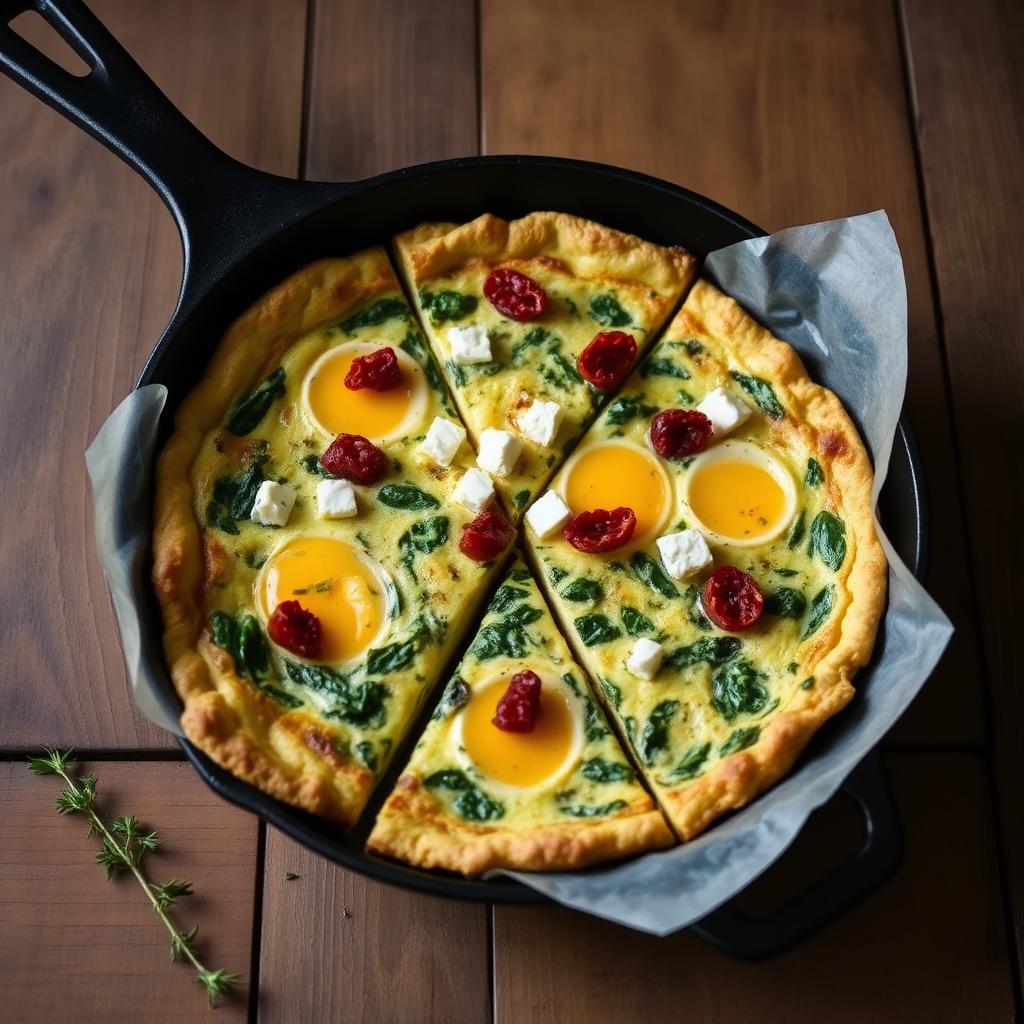
There is a specific kind of quiet that only exists in a kitchen before the rest of the house wakes up—a heavy, expectant silence punctuated only by the hum of the refrigerator and the distant call of a morning bird. In these moments, I find myself craving something that feels substantial yet bright, a dish that bridges the gap between the dark, earthy depths of winter and the sharp, solar promise of spring. This Spinach, Feta, and Sundried Tomato Frittata is that bridge. It is not just a standard egg bake; it is a study in textures. The eggs are whisked into a custardy submission, then folded around the iron-rich bite of spinach and the concentrated, umami-laden chew of sundried tomatoes. The feta doesn't melt into the background; it remains in proud, salty outcrops that startle the palate. It is a humble meal, born of the pantry and the crisper drawer, yet it possesses a sophisticated architecture that makes it feel like an event.
The story
Why this one stuck
In the late nineties, my aunt Thalia lived in a house that smelled exclusively of dried oregano and floor wax, perched on a steep, precarious hill in Astoria, Queens. She was a woman of fierce opinions and very few words, most of which were directed at the quality of the produce I brought over. To Thalia, a kitchen was a laboratory where the only variable that mattered was the 'salt of the earth.' She didn't believe in recipes; she believed in the weight of a handful and the sound of a sizzle. It was in her linoleum-clad kitchen that I first learned the alchemy of the frittata.
I remember a particular Tuesday, the sky the color of a bruised plum, when she pulled a rusted cast-iron skillet from the depths of her oven. She had spent the morning complaining about the 'anemic' spinach from the corner bodega, yet as she tossed it into the oil, it transformed into something regal. She taught me that the secret to a great frittata isn't just the eggs—it’s the 'dryness' of the vegetables. 'If you cook the water out of the greens, you leave room for the soul of the olive oil,' she’d say, her voice gravelly and certain. She’d press cubes of feta into the golden batter with a thumb that bore the permanent green stain of herbs.
We would sit at her tiny yellow table, the subway rattling the windows every ten minutes, and eat wedges of this specific combination: the spinach, the jarred tomatoes she’d brought back from a trip to Italy, and the feta that was so sharp it made the back of my throat tingle. It was a lesson in balance. The sundried tomatoes were like little leathery rubies, offering a concentrated sweetness that fought against the vinegar-bite of the cheese. There was no 'game-changer' moment, no cinematic epiphany—just the steady, rhythmic chewing and the realization that something made from the scraps of a pantry could taste like a deliberate masterpiece.
Thalia is gone now, and her Astoria house has been replaced by a glass-fronted condo, but whenever I crack an egg against the side of my own cast iron, I hear her scoffing at my technique. I make this version in her honor, keeping the feta in large, defiant chunks and ensuring the spinach is wilted to the point of total surrender. It is a recipe that requires you to pay attention to the bubbles, to the smell of the garlic just before it turns, and to the height of the broiler flame. It is a piece of her kitchen, resurrected in mine.
What you'll need
Ingredients
- 10 large farm-fresh eggs, room temperature
- 1/2 cup whole milk or heavy cream
- 1/2 teaspoon kosher salt (be cautious, feta is salty)
- 1/2 teaspoon freshly cracked black pepper
- 1/4 teaspoon nutmeg, freshly grated
- 2 tablespoons extra virgin olive oil (from the tomato jar is best)
- 1 medium shallot, minced fine
- 2 cloves garlic, smashed and minced to a paste
- 6 ounces fresh baby spinach, roughly chopped
- 1/2 cup oil-packed sundried tomatoes, drained and julienned
- 4 ounces high-quality Greek feta, crumbled into large chunks
- 1/4 cup Parmigiano-Reggiano, finely grated
- 2 tablespoons fresh dill, chopped
- 1 teaspoon lemon zest, microplaned
Step by step
How to make it
- 01
Begin by positioning your oven rack in the upper-middle slot and preheating your broiler to high. While the oven heats, crack your ten eggs into a wide ceramic bowl. Add the whole milk, kosher salt, black pepper, and that essential pinch of nutmeg. Whisk with a vigorous, rhythmic motion until the yolks and whites are indistinguishable and a few tiny bubbles crown the surface. Do not over-beat to the point of foam, but ensure the texture is entirely homogenous to avoid white streaks in the final bake.
- 02
Place a 10-inch well-seasoned cast-iron skillet over medium heat. Pour in two tablespoons of the oil from the sundried tomato jar; it is already infused with herbs and the essence of the fruit, providing a head start on flavor. Once the oil shimmers, toss in the minced shallot. Sauté for about three minutes until the shallot loses its opacity and begins to turn a pale, translucent gold. Add the garlic paste and cook for just thirty seconds, stirring constantly to prevent the bitter tang of scorched garlic.
- 03
Add the chopped baby spinach to the skillet in three batches. This may look like an absurd mountain of greens, but they will collapse into almost nothing within minutes. Use tongs to toss the spinach in the hot oil, wilting it until it is a deep, vibrant emerald. Continue cooking for an extra minute after it wilts to allow any excess moisture to evaporate from the pan. This step is crucial for preventing a watery frittata. Stir in the julienned sundried tomatoes to warm them through.
- 04
Reduce the stovetop heat to medium-low. Ensure the spinach and tomato mixture is spread into an even layer across the bottom of the pan. Pour the egg mixture over the vegetables. Use a heat-resistant spatula to gently swirl the eggs, lifting the cooked edges and allowing the raw egg to flow underneath, much like making an omelet. Do this for about two minutes until the bottom is set but the top remains a liquid, golden lake. Stop stirring once the base feels structurally sound.
- 05
Scatter the crumbled feta and the grated Parmigiano-Reggiano evenly over the top of the eggs. Don't press them in; let them sit on the surface like little snowy islands. The feta should be in substantial chunks so that you encounter distinct pockets of creamy tang rather than a uniform saltiness throughout. Sprinkle the lemon zest and half of the fresh dill over the cheese. The zest provides a necessary high note to cut through the richness of the eggs and oil.
- 06
Transfer the skillet immediately to the preheated broiler. This is the moment of maximum vigilance. Stay by the oven door. You are looking for the eggs to puff up like a bellows and the cheese to develop charred, mahogany freckles. This usually takes between 3 and 5 minutes depending on the ferocity of your broiler. The center should still have a very slight, tectonic shimmy when you shake the pan—the carryover heat will finish the setting process.
- 07
Carefully remove the skillet from the oven using a heavy-duty mitt; the handle will be screamingly hot. Let the frittata rest in the pan for at least five minutes. This rest period allows the internal steam to settle and ensures the slices come out cleanly without tearing. During this time, the edges will pull away slightly from the cast iron, signaling that the frittata is ready to be released from its vessel.
- 08
Garnish the top with the remaining fresh dill and a final crack of black pepper. Slide a thin offset spatula or a butter knife around the perimeter to ensure total freedom. You can serve it directly from the pan for a rustic table presentation, or slide the entire disc onto a wooden board. Cut into thick, generous wedges and serve warm or at room temperature, perhaps with a side of dressed arugula to mimic the bitterness of the spinach.
Cook's notes
Tips for your best result
- 01Use room temperature eggs to ensure a more even, lofty bake; cold eggs can shock the hot pan and lead to uneven cooking.
- 02Don't skimp on the nutmeg; it doesn't make the dish taste like dessert, but rather enhances the savory, metallic notes of the spinach.
- 03Always use the oil from the sundried tomato jar for sautéing the shallots; it’s a concentrated flavor bomb you’ve already paid for.
- 04Crumble your own feta from a block kept in brine; pre-crumbled cheese is coated in cellulose to prevent clumping, which ruins the melt.
- 05Watch the broiler like a hawk; thirty seconds is the difference between a golden masterpiece and a charred, blackened ruin.
Make it yours
Variations
While the spinach and feta combination is a classic for a reason, the frittata is a gloriously blank canvas. For a more autumnal profile, swap the spinach for thinly sliced lacinato kale and replace the feta with sharp white cheddar or Gruyère; the kale requires a slightly longer sauté to soften its fibrous ribs. If you desire a smoky undertone, fold in a half-cup of diced smoked provolone or a pinch of pimentón (smoked paprika) into the egg mixture. For those who crave heat, a tablespoon of Calabrian chili paste stirred into the shallots adds a lingering, glowing warmth that plays beautifully against the sundried tomatoes. You can also experiment with the 'allium base'—using leeks instead of shallots provides a milder, more buttery sweetness, while adding a handful of scallions at the very end of the stovetop process lends a fresh, grassy crunch. For a vegetarian version that mimics bacon, try adding some smoked dulse seaweed or highly seasoned roasted mushrooms. Regardless of the inclusions, maintain the ratio of 10 eggs to 1/2 cup of dairy to ensure the structural integrity of the custard remains intact.
Keep it fresh
Storage & make-ahead
The beauty of a frittata lies in its resilience. To store, let the dish cool completely to room temperature; placing a hot frittata in a container will create condensation, leading to a soggy texture. Once cool, wrap individual wedges in parchment paper and then place them in an airtight container. They will thrive in the refrigerator for up to four days. For longer storage, you can freeze the wedges for up to a month, though the texture of the eggs will become slightly grainier upon thawing. To reheat, I strongly advocate for the oven or a toaster oven at 300°F (150°C) for about ten minutes. This preserves the structural integrity of the feta and keeps the eggs tender. If you must use a microwave, use the 50% power setting to avoid turning your breakfast into a vulcanized rubber puck. Interestingly, many aficionados (myself included) believe a cold frittata wedge, eaten unceremoniously over the sink, is the ultimate secret snack.
Reader questions
Frequently asked
Why did my frittata turn out rubbery?
Rubbery eggs occur when the proteins are over-coagulated by heat, pushing out the moisture you want to keep. This usually happens if the pan remains in the oven too long or the heat is too high. Aim to pull the frittata when the center has a slight, jelly-like wobble. Carryover heat will finish the job while it rests on the counter, ensuring a custard-like bite rather than a bouncy, sulfurous one.
Can I use frozen spinach instead of fresh?
Frozen spinach is a moisture bomb that can turn your frittata into a soggy, green puddle. If you must use it, you need to thaw it completely and squeeze it within a clean kitchen towel until every possible drop of water is expelled. You’ll be left with a dense puck of greens. Break this up thoroughly before adding it to the eggs to ensure even distribution and to prevent unpleasant watery pockets in the bake.
Is the dairy strictly necessary?
Dairy is the secret to that coveted, creamy mouthfeel. The fat in the whole milk or heavy cream coats the egg proteins, preventing them from bonding too tightly and becoming tough. I recommend whole milk as the baseline, but substituting half-and-half or a splash of heavy cream will yield an even more luxurious, quiche-like interior. Avoid skim milk, as it lacks the structural integrity needed for this recipe.
What if I don't own a cast-iron skillet?
Cast iron is king because it holds a massive amount of residual heat, which helps cook the bottom of the frittata while the top browns under the broiler. However, any heavy, oven-safe non-stick or stainless steel skillet will suffice. Just ensure the handle is rated for high oven temperatures. If using stainless steel, be extra generous with the olive oil to prevent the eggs from welding themselves to the pan.
Should I use oil-packed or dry-packed sundried tomatoes?
The sundried tomatoes in oil are far superior for this application because they are already reclined in a softened state. Dry-packed tomatoes are often leathery and can be quite jarring in a soft egg dish. if you only have the dry kind, soak them in boiling water for fifteen minutes and then pat them dry before slicing. This replicates the texture of the oil-packed variety and protects your teeth from unwanted chewiness.
Can this be made ahead for a brunch party?
Absolutely. A frittata is perhaps the most resilient 'leftover' breakfast in existence. It is arguably better the next day when the garlic and feta have had time to fully infuse the egg matrix. You can eat it cold, straight from the fridge, which highlights the sharpness of the feta, or gently reheat it in a low oven. Microwaving is possible but do it in short bursts to avoid toughening the eggs.